Dress Shirts – Darts

What Are Darts?

Darts are two seams sewn into the back of a shirt that together remove a total of 1.5” of fabric. Each dart takes out .75” at its widest point.

Darts start just below the armpit, gradually becoming larger until their widest point at the midsection, decreasing in size until they end a few inches above the shirt bottom. Shirts with darts will have a front panel of the shirt that is wider than the back panel.

Back Darts

Back Darts

What Do Darts Do?

Darts are popular for removing excess fabric from the lower back of a shirt. Many guys will have lower backs that curve inward, so removing fabric from this portion of the shirt can help the shirt follow the lines of their body more closely.

If you are constantly bothered by extra fabric in the lower back, but feel slimming the midsection of the shirt evenly in the front and back will cause the shirt to be too slim around your stomach, then darts may be great for you.

How Do I Use Darts?

Simply adding darts will not make the shirt slimmer—it will keep the midsection width the same when measured flat. The 1.5” taken from the back is automatically added to the front panel of the shirt.  To achieve a slimmer fit with darts, you must lower the midsection width with darts selected.

If your fit is already slim at the front of the stomach and you’d like to just reduce fabric at the lower back, we suggest lowering your midsection width by .5” with darts selected.

Style Implications

Darts will add another element of design to the shirt. Some find that darts give the shirt a more European, modern look. Darts are often associated with shirts from brands such as Prada, Dolce & Gabbana, and Hugo Boss.

Formaldehyde in Clothing and Non-Iron Shirts

History of Formaldehyde in Textiles

Formaldehyde resins have been used to treat textiles, particularly cotton since the 1920’s. Formaldehyde treatments are usually applied to combat wrinkling, improve stain resistance/colorfastness, and prevent mildew. Essentially, it has been used to make apparel fabrics easier to care for, transport, and manufacture over the last 100 years.

Government Regulations Improve Consumer Safety

Not until 1973 were formaldehyde levels in textiles monitored for safety purposes by the Government Accountability Office (GAO). The results indicated that an insignificant number of people were actually affected by this treatment of textiles. A similar study was performed in 1984, again revealing that textile treatment was not a health concern, with an insignificant number of subjects experiencing mild skin irritation.

In the textile industry, regulations dictate that 100 ppm (or less) formaldehyde concentration in textiles is safe for human contact. In the previously mentioned 1984 study, 67% of apparel tested for formaldehyde indicated levels above 100 ppm. However, with the rise in regulations worldwide to protect textile/apparel laborers and consumers alike, GAO reports from 2003 and later have found less than 2% of apparel in the US tested above 100 ppm.

Allergic (Skin Irritation) Reactions Affect Few

The main health concern related to formaldehyde in apparel is allergic contact dermatitis (itchy rashes caused by skin contact). Again, the 1984 study revealed that less than 2% of the population experienced skin irritation, even at a time when overall formaldehyde levels in clothing were much higher than at present.

“Basically, this has not been a problem for years,” says Phillip Wakelyn, a fabric consultant in Washington, D.C., who worked for many years in the apparel and cotton industry. “I have dealt with this issue since the Occupational Safety & Health Administration was working on a standard for formaldehyde in the early 1980s.” Further, he adds, “Studies done over the past 20 years show that you would need a concentration of about 300 ppm on the fabric before dermatitis is likely to be a problem.”

However, for consumers with notoriously sensitive skin or those that just wish to play it safe, it’s best to wash all clothing before wearing.

Airborne Formaldehyde vs. On-Fabric

The general population’s worry over formaldehyde in clothes may come from recent reports on the potential risk of cancer from airborne exposure to formaldehyde. Airborne formaldehyde is much riskier and has documented serious health effects, thus it is very strictly regulated.

Because airborne formaldehyde is significantly more harmful than textile formaldehyde, OSHA regulations suggest a much lower threshold for airborne exposure, usually around .5 ppm. However, once a shirt is outside of the treating location it is extremely unlikely for any formaldehyde in the fabric to become airborne at all and very little is even transferred to the skin. For these reasons and the previously described testing, any fabrics under 100 ppm are deemed safe for daily usage. But we do suggest washing any formaldehyde treated fabrics to further minimize this already negligible risk and avoid any potential allergic reactions for sensitive skin.

Proper Cloth Non-Iron Shirt Treatment

Proper Cloth non-iron dress shirts achieve their wrinkle free finish through a specially developed chemical process. After your custom dress shirt is cut and sewn to your size and design specifications, it is dipped in a chemical resin. We use special fabrics that are prepared by our fabric mills to accept this non-iron treatment. The non-iron treatment saturates the entire shirt, bonding the cotton fibers to each other at a molecular level, making the fabric much more difficult to crease. The shirt is then heat cured to lock in the non-iron treatment. Finally, the shirt is pressed and packaged.

Proper Cloth’s non-iron treatment reflects very safe formaldehyde levels of under 35 ppm. This is less than half of international textile standards’ recommended 75 ppm. 

In terms of care, we recommend having your Proper Cloth non-iron shirts washed and pressed at the cleaners or washed and lightly tumble dried at home. An added benefit of the heat curing process involved in finishing our non-iron shirts is that heat improves the finished shirts’ wrinkle resistance. For this reason, a low temperature tumble dry can produce excellent wrinkle-free results, ironing is easier than ever, and just by wearing a non-iron shirt, your body heat can improve wrinkle-resistance.

More about Proper Cloth’s custom Non-Iron Dress Shirts.

*Source: https://pubs.acs.org/cen/government/88/8836gov2.html

Converting a Long Sleeve to a Short Sleeve Size

Converting to a Short Sleeve Size

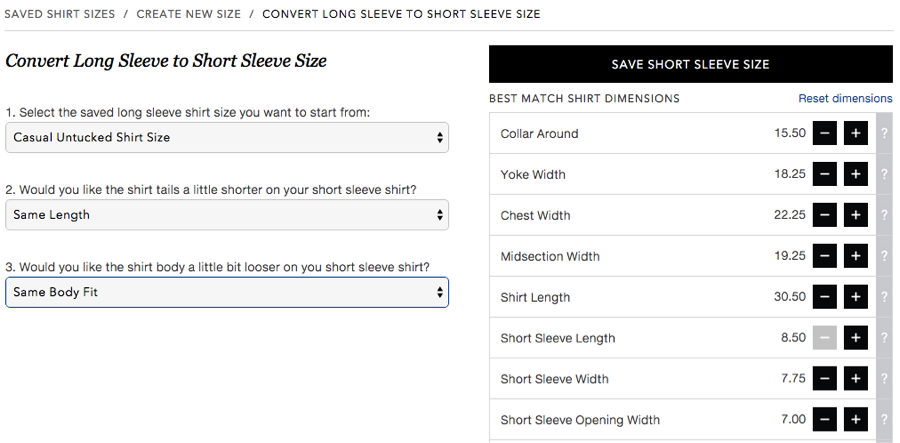
Proper Cloth provides a tool to automate the process of creating a Short Sleeve shirt size. Head to your Custom Sizes page, then click the “+ Create New Size” button to get started. Scroll to the bottom, click the Select button on “Convert a Long Sleeve Size to Short Sleeve” and answer three questions to save a short sleeve size.

Convert Long Sleeve to Short Sleeve

Create a Casual Size First

You may find it helpful to read our guide on creating a casual, untucked shirt size first. Then, you can use the tool to simply convert your casual, untucked size into a short sleeve sleeve shirt with the same back length and body fit.

Tucked-in Dress Shirts vs Untucked Casual Shirts

With Proper Cloth you can order custom shirts in any size and style you desire. Perhaps you have your dress shirt fit perfected and are looking to create a casual shirt to wear untucked outside of the office. Below are tips for creating this new size and perfecting your untucked, casual shirt fit.

Casual untucked shirt.

Shorten the Shirt Length

Generally speaking, the biggest difference between tucked-in dress shirts and untucked casual shirts is the shorter shirt length. We recommend shortening the shirt length anywhere from 1.5” to 2.5” for an untucked, casual size based on your dress shirt fit.

Increase the midsection

If you are wearing your dress shirts on the slimmer side in the midsection, you’ll definitely want to increase the midsection width by at least .5” – 1” to allow the shirt to fall straighter and not create an hourglass silhouette at your hips. If the midsection is too trim on a shirt you plan to wear untucked, you will find the shirt bunching up at the waistline and not falling comfortably over the top of your pants.

Widen the Chest and Sleeves

Additionally, some find that increasing the chest width .5″ makes for a more comfortable, easygoing look. This is particularly true if you’ve dialed in your dress shirts to a razor sharp tailored fit. If your dress shirts err on the comfortable and classic fit side, then you can skip the additional fine-tuning and just shorten the shirt length for your ideal untucked size.

Wrinkle-Resistant vs Non-Iron Dress Shirts

Morris Wrinkle-Resistant Houndstooth Fabric

What’s the difference in wrinkle resistance between non-iron and wrinkle-resistant dress shirts?

Non-Iron dress shirts will generally have superior wrinkle-resisting performance compared to wrinkle-resistant shirts.

Wrinkle-resistant dress shirts definitely need to be ironed or pressed after they are washed for a clean, professional appearance. The treatment is such that your shirts stay looking sharper throughout the day than they otherwise would, were they not treated.

Non-Iron shirts, on the other hand, require little-to-no ironing following a wash at home to achieve a flawless appearance. If you have your non-iron shirts washed and pressed at the cleaners, even better. With normal wear over the course of the workday you’ll find the shirt to be relatively unchanged, aside from points of articulation like the inside of the elbows.

What’s the difference in feel between non-iron and wrinkle-resistant shirts?

Wrinkle-resistant treated fabrics tend to look and feel similar to untreated fabrics. The treatment is applied to the fabric during the finishing process, rather than the fully finished shirt, allowing for enhanced breathability and softness. Another factor in the breathability and softness is the fact that all Proper Cloth wrinkle-resistant fabrics are 100% cotton.

With non-iron shirts, the bonded cotton fibers are a double-edged sword. They allow for an unmatchable wrinkle-free finish, but also cause the fabric to be less breathable and a little less smooth to the touch. It’s important to us that we use high-quality fabrics for our non-iron shirts, such as our 100% cotton Non-Iron 100s White Supima Twill, so that Proper Cloth non-iron shirts will wear much more comfortably than non-iron shirts from mass market retailers.

How is the manufacturing process different for wrinkle-resistant fabrics vs. non-iron shirts?

At Proper Cloth, we choose to treat our “Wrinkle-Resistant” fabrics with a water-based chemical process that occurs at the mill level, rather than once the shirt is made. The fabric is treated during the production process and later arrives at our manufacturing facility, ready to be cut to your custom size and design specifications in the wrinkle-resistant material.

Non-Iron shirts are different in that your shirt is cut and sewn to your size and design specifications and then placed in a non-iron treatment vat. We use special fabrics that are prepared by our fabric mills to accept this non-iron treatment. The non-iron treatment saturates the entire shirt, bonding the cotton fibers to each other at a molecular level and making the fabric much more difficult to crease.

Other factors that determine wrinkle-resistance

One shouldn’t forget that the underlying fabric weave, weight, and cotton quality of a fabric play a very important role in its overall wrinkle resistance.

Generally, thinner fabrics made with single ply construction will wrinkle more easily than 2-ply fabrics with a bit more body. Broadcloth (also known as poplin) wrinkles most easily of the fabric weaves, so if you really care about having a shirt that’s easy to maintain we suggest going for a twill, pinpoint, or royal oxford.

High thread count fabrics (120s-170s) tend to be slightly more fragile and prone to wrinkling than many fabrics, so we find the best natural wrinkle resistance will come with fabrics made in 80’s or 100’s 2-ply construction.

Proper Cloth’s Top Non-Iron Styles

The Non-Iron Supima Shirt

The Non-Iron Button Down

The Non-Iron Stretch Shirt

The Thomas Mason Non-Iron Shirt

Proper Cloth’s Top Wrinkle-Resistant Styles

The Mayfair Wrinkle-Resistant Shirt

The Thomas Mason Wrinkle-Resistant Shirt

History of non-iron and wrinkle-resistant shirts

Non-Iron shirts were first introduced in the early 1990s and were slowly adopted by shirtmakers at first. It wasn’t until the late ’90s that these shirts started being widely offered, though. Non-Iron shirts really took off in the 2000s, accounting for almost 25% of dress shirts sold in the US in 2008.

Number of Buttons on Shirt Front

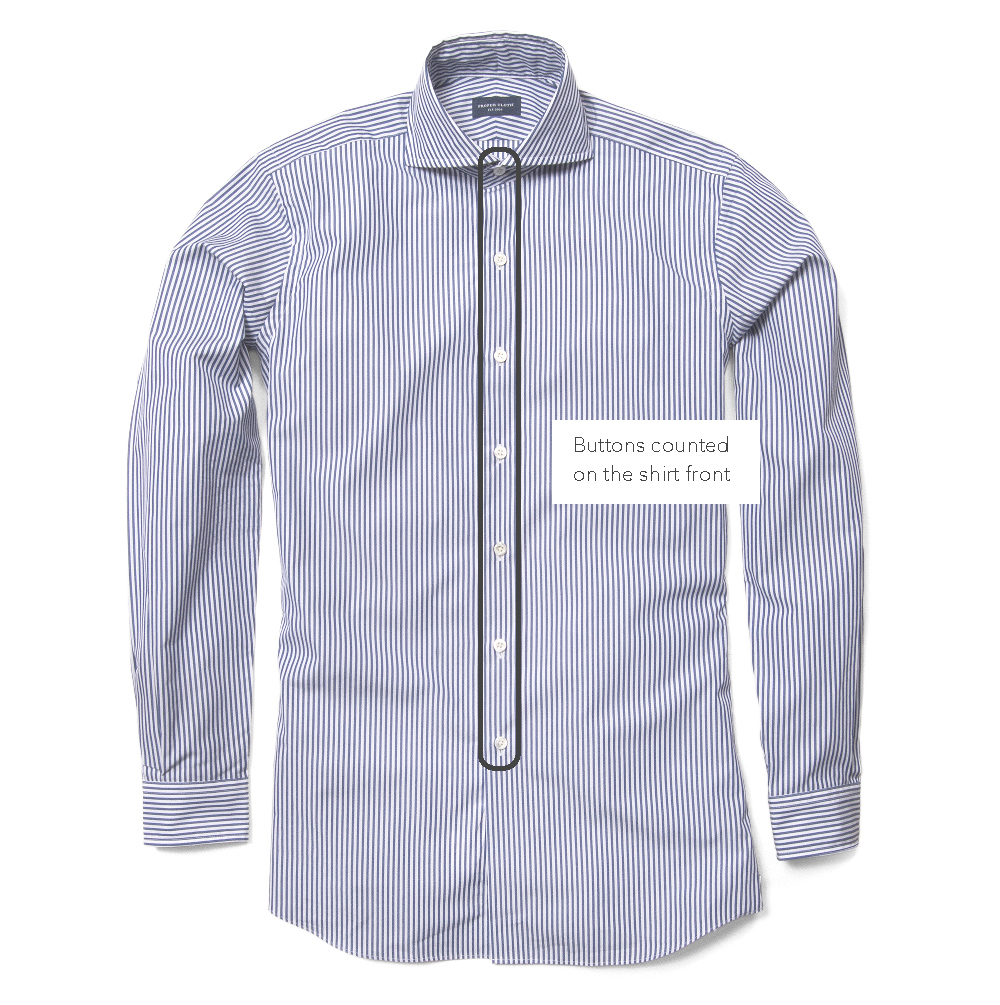
The number of buttons on the front of your shirt is a function of the Top Button Placement, the Back Length, and your Posture setting.

Buttons of the front of a shirt.

Buttons on Shirt Front

Generally speaking, longer shirts or shirts with a higher Top Button Placement will have more shirt buttons on the front.  The exact logic is complicated to explain, so we updated the sizes interface to calculate and display the number of buttons that will be on the front of the shirt based on the shirt length and top button placement.

As of June 4th, 2020, we updated our system to automatically adjust the distance between the buttons (not counting the collar button) based on the Top Button Placement, the Back Length, and your Neck Posture setting.

Button Spacing options are 3 1/8″ (3.1″), 3 1/4″ (3.3″) or 3 1/2″ (3.5″). We dynamically change this to help maintain an optimal placement for the bottom button that is not too close or too far from the bottom of the shirt.

Shirts: Top Button Placement

top button placement

Proper Cloth offers the ability to adjust how high or low you’d like the first button below the shirt collar to be placed, but it may not be obvious why you would like to adjust this part of your shirt. Typically, our standard placement is just a shade below the “industry average,” to allow for a better look with your collar undone and the first placket button fastened.

Per the opening dialogue of season one, episode one of Seinfeld:

JERRY: Seems to me, that button is in the worst possible spot. [talking about George’s shirt] The second button literally makes or breaks the shirt, look at it: it’s too high! It’s in no-man’s-land, you look like you live with your mother.

Standard Top Button Placement

By default, we place the top button such that its center is 2 7/8″ below the bottom of the collar band.

Spacing Between 2nd, 3rd, 4th, etc. Buttons

Button Spacing refers to the distance between the buttons on the shirt front measured from button center to button center. This is different from the distance between the collar button and the top shirt button, which is controlled by Top Button Placement.

Button Spacing cannot be specified directly. It is automatically determined by the system based on the shirt Back Length, Posture, and Top Button Placement settings. Button Spacing options are 3 1/8″ (3.1″), 3 1/4″ (3.3″) or 3.5″.

By adjusting the spacing between the buttons slightly we’re able to better optimize the position of the bottom button on the shirt relative to the shirt tail (‘Bottom Distance’) and avoid it being too close or too far away from the end of the shirt.

Top Button Placement Options

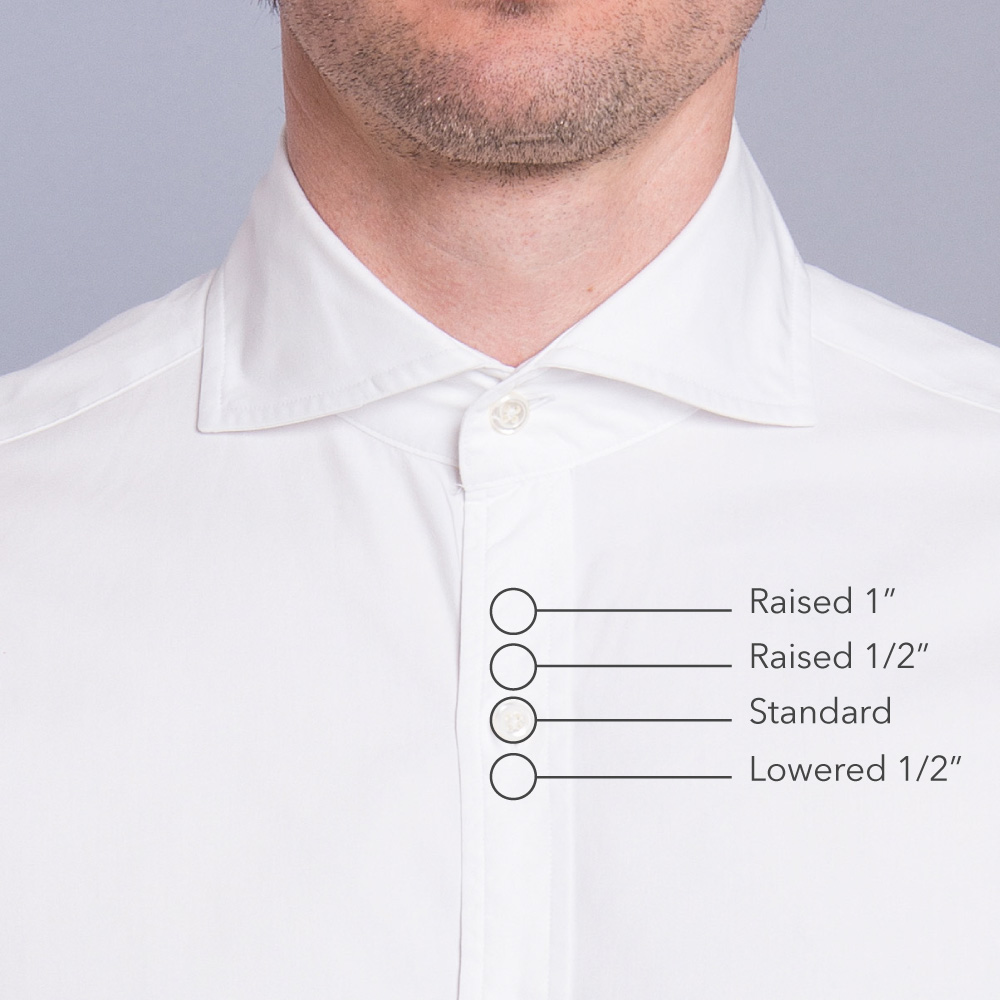
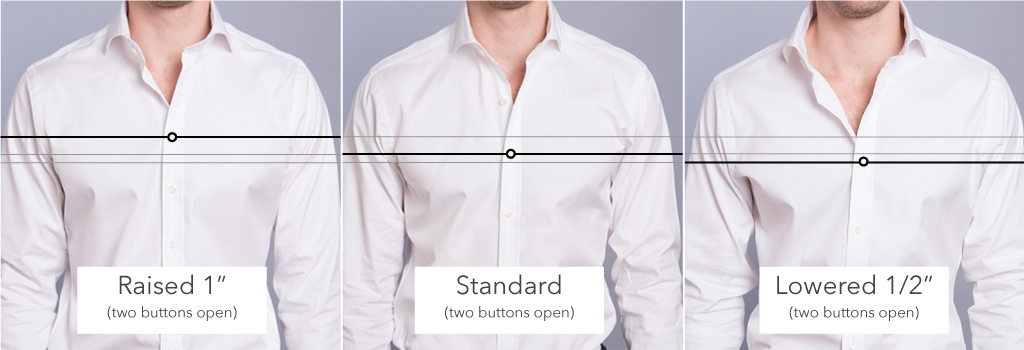
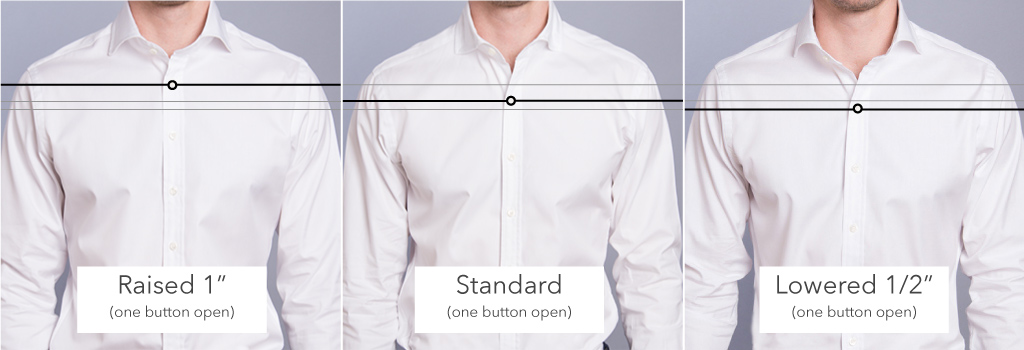
We offer four different options: “Raised 1”, “Raised 1/2”, “Standard”, “Lowered 1/2”.

  • Selecting Raised 1″ raises the first button on the placket of the shirt up 1″ from our standard.  This decreases the space between the bottom of the collar band and this button from 2 7/8″ to 1 7/8″.
  • Selecting Raised 1/2″ raises the first button on the placket of the shirt up 1/2″ from our standard.  This decreases the space between the bottom of the collar band and this button from 2 7/8″ to 2 3/8″.
  • Selecting Standard is the default setting.  This centers the top button 2 7/8″ from the bottom of the collar band.  *Note that our standard button placement is already just slightly lower than what many consider “normal”, so if you’re looking for a lower button placement on your first order, do not necessarily start with Lower 1/2″.
  • Selecting Lowered 1/2″ lowers the first button on the placket of the shirt down 1/2″ from our standard.  This increases the space between the bottom of the collar band and this button from 2 7/8″ to 3 3/8″.
Top Button Placement

Top Button Placement

Reasons to Change Top Button Placement

Most people won’t need to change the first button placement on their shirts, but here are some reasons to consider it.

The Placket Bump

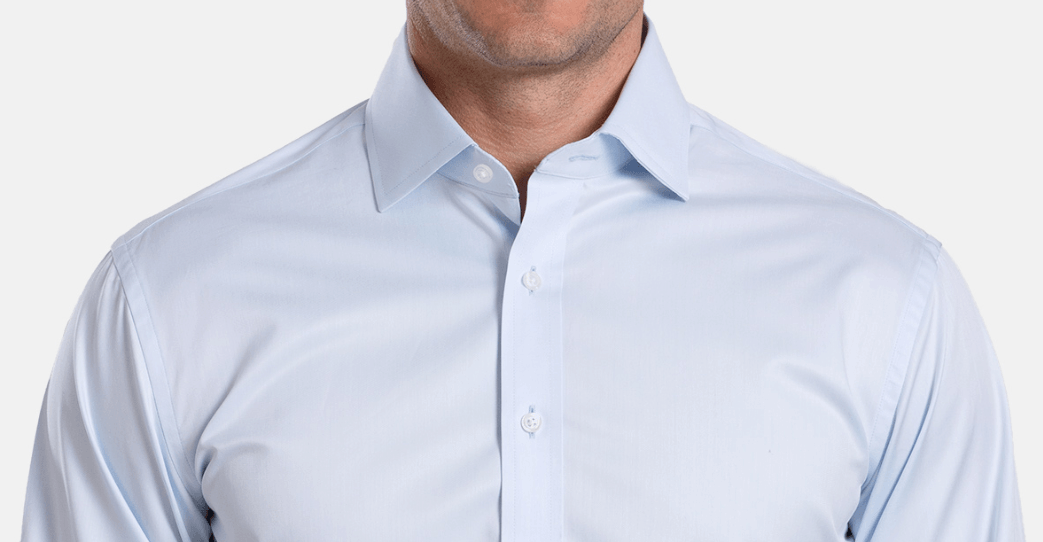
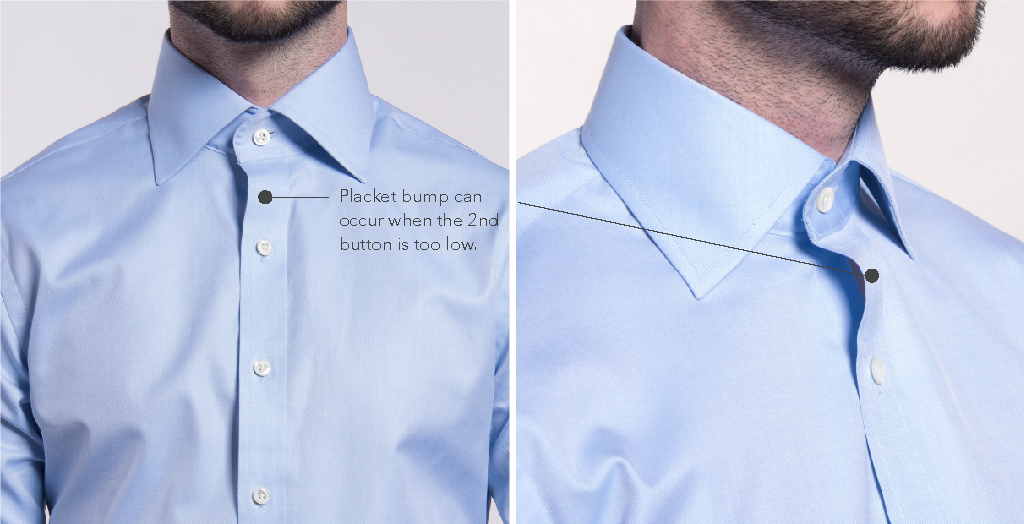
The primary fit problem that can be addressed with button placement is when you notice a “bump” between the collar button and the first button on the placket. Generally this problem resolves itself when a tie is worn, and is not an issue if the collar is left unbuttoned.  However, if you’re wearing the shirt buttoned all the way up without a tie, or if you have a particular posture that causes this to be a problem even with a tie on, you will want to consider this adjustment.

Dress Shirt Placket Bump

Dress Shirt Placket Bump

This issue can be improved or totally eliminated by raising the position of the first button on the placket. By raising this button 0.5″ or 1″, the space between the collar and top button is reduced and the placket becomes much more likely to lay flat to the body, regardless of your fit profile.

Perfecting Your Unbuttoned Look

Some guys prefer to wear the collar button and the top placket button unbuttoned, but find that this shows just a bit more chest than they are comfortable with. Switching to Raised 1/2″ or Raised 1″ raises the 2nd button placement by the same amount, which reduces the amount of chest that will show.  This can help with hiding chest hair or a v-neck undershirt’s visibility. The images below illustrate how raising the top button can allow the second button to better cover your chest hair or v-neck undershirt.

4b

Conversely, some guys like to wear their collars open, but keep all the buttons below the collar buttoned. If you wear your shirts like this, you may find that the top button placement is just a little too restricting for your taste.  Switching to Lowered 1/2″ can help relax the look just slightly.  The images below illustrate how the look can change when you alter the top button position and only unbutton the collar button. Button Placement

Opacity Ratings

Proper Cloth’s Opacity Ratings:

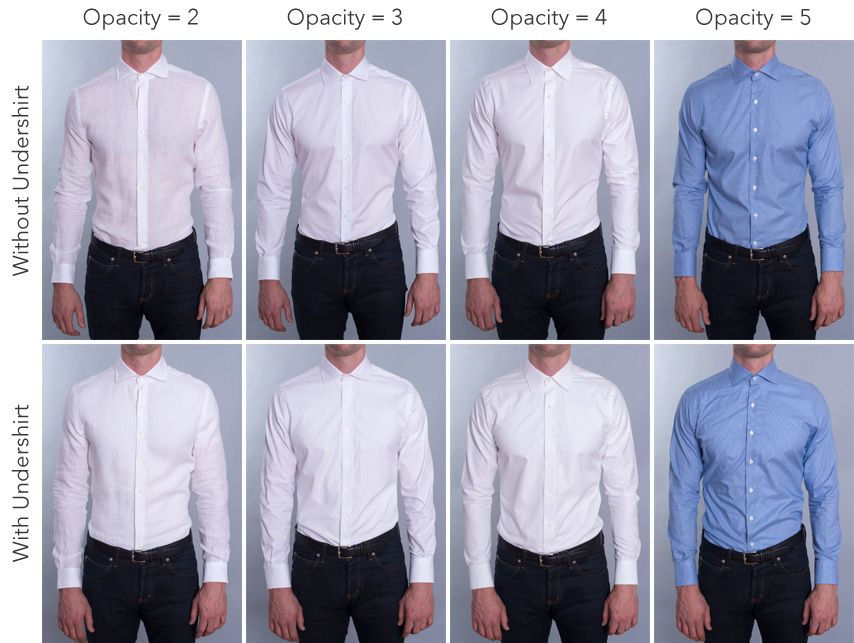
We rate each of our fabrics in terms of its opacity to give customers a good idea of what to expect from them. We do this on a 1-5 scale, with 1 being the least opaque and 5 being the most opaque.

5 – Maximum Opaqueness

We don’t expect anyone to have an issue with the opacity of this fabric. It shouldn’t show through and should retain its color regardless of the color of the skin or hair below the fabric.

An example of a 5/5 rating would be our Black Heavy Oxford (PCF1112). 

4 – Very Opaque

Our 4/5 opacity rating is our most popular rating. We rarely have issues with customers finding these fabrics to be sheer. Most non-white or patterned fabrics will be in this category.

An example of a 4/5 opacity rating is our Mayfair Wrinkle-Resistant Light Blue Houndstooth – PCF1986. The subtle houndstooth pattern, twill weave, and light blue color create a visual effect that makes this more opaque than if it were non-patterned or if it were a white fabric of the same weight.

3 – Fairly Opaque

This is where many of our white or light blue solid fabrics fall. Most guys shouldn’t have opacity issues with these, but if you’re the type who knows he wants a particularly opaque fabric then we suggest opting for a fabric with a 4/5 or 5/5 rating.

An example of a 3/5 opacity rating is our Non-Iron Supima White Pinpoint Fabric – PCD001. This is a medium to lightweight white pinpoint, so because it has no pattern or color it will be more likely to show through. We’ve had some customers who are particularly sensitive to opacity find this fabric to be a little too sheer for their preference.

 2 – Slightly Transparent

These fabrics are generally lightweight summer fabrics, often made with a looser weave and/or linen. Typically, these are the most breathable shirts and can be super comfortable in the summer, but you have to be okay with them showing through in certain situations.

An example of a 2/5 opacity rating is our Thomas Mason White Luxury Broadcloth – PCF1615. It’s a very lightweight fabric that you will be able to see your skin color through when you’re not wearing an undershirt. If transparency is a concern for you, we suggest avoiding fabrics with a 2/5 opacity rating.

1 – Very Transparent

The very transparent fabrics we carry are much like the slightly transparent fabrics in that they are lightweight and made with looser weaves and/or linen. They are also generally white, which is the easiest color to see through. These fabrics are also usually quite casual in nature. 

An example of a 1/5 opacity rating is our Baird McNutt White Irish Linen – PCF3009. The light weight of this fabric contributes to its breathability, but, in combination with its white color, makes it very transparent. If transparency is a concern for you, we suggest avoiding fabrics with a 1/5 opacity rating.

Dress Shirt Opacity on Dark Skin Tone
Dress Shirt Opacity on Light Skin Tone

A Very Opaque White Shirt

A luxurious, densely woven twill that’s perfect for a big event. This one is a very unique style we specifically selected for its opacity and clean drape. Thomas Mason uses a special 120s 3-ply construction to achieve this performance. Because the weave is fine, it appears totally clean and without texture from a distance, while the twill gives it that pinch of shine that gives a white shirt remarkable vibrance. Medium-heavyweight thickness, 4/5 opacity rating—this is the most opaque, plain white office or formal shirt you will find.

Thomas Mason White 3 Ply Regal Twill


Opacity – An Overview

Shirts can be made from a wide variety of fabrics—from thick heavy flannels to the thinnest cotton and linen blends. Typically, weight and color dictate the opacity of a fabric. The thicker a fabric is the more opaque it will be, and the closer to white a color is the more it will show through.

These aren’t the only considerations, though. The weave of a fabric and type of yarn used can come into play. Shirts with wool woven into them almost always tend to be more opaque, whereas 100% linen or cotton/linen shirts tend to be more sheer. Additionally, a fabric can be more or less opaque depending on whether it’s an oxford, a pinpoint, a twill, a broadcloth, or a jacquard.

Twills are some of the most dense weaves, so they will often be more opaque than oxfords and pinpoints of similar weights, which are woven a little more “loosely” or are what’s called “open.” Broadcloth (or poplin) is more difficult to weave with a very high density, so most broadcloths will tend to weigh less than twills, oxfords, and pinpoints. Because of this, broadcloth is generally the least opaque fabric weave type.

While many guys will never have an issue with opacity, there are some who find this to be the most important aspect of their shirt. Those with darker skin, or guys with (especially) hairy chests are most likely to have issues with fabrics showing through.

Tuxedo Shirt Styles

There are several styles of dress shirt that can be appropriate for wearing with a tuxedo. The following is an explanation of the three options we have that accommodate tuxedo studs: Pleated Front, Pique Bib Front and Plain Tuxedo Front. This post also explains how the removable faux pearl buttons work and has some other style suggestions for Tuxedo shirts. For more information on recommended formal attire, see Proper Cloth’s official Tuxedo Shirt Guide.

A Tuxedo Shirt Look

Pleated Front

The pleated tuxedo shirt front has pleats down the front of the shirt. The pleats are made with the actual fabric of the shirt, so they will match the rest of the shirt precisely (no matter what fabric you’ve selected for the shirt). Our design has 10 pleats on each side of the shirt, and a fused placket in the center of the shirt. The pleats measure about 10″ across the front of the shirt. Each pleat is about 7/16″ wide. Since the pleats are made from the shirt fabric itself they run all the way to the bottom of the shirt front.

Pleated Front Tuxedo Shirt

Pleated Tuxedo Shirt Front with Studs

Piqué Bib Front

The piqué bib front tuxedo shirt has a special pique fabric sewn on the front.  This is a beautiful fabric from Thomas Mason with the classic piqué texture.  The bib is 10 inches wide and goes just below the 5th button.  There is no placket added to this shirt style, so the front is very clean and simple.

Piqué Bib Front Tuxedo Shirt

Piqué Bib Tuxedo Shirt Detail with Studs

Plain Tuxedo Shirt Front

The plain tuxedo shirt front is basically just like a french front, except (like the other tuxedo fronts) the top four buttons are removable so that the shirt can be worn with studs.

"</p

The plain tuxedo front is the most modern, minimalist option and a Proper Cloth favorite.  It’s a particularly clean finish to the shirt front and with tuxedo studs it’s particularly elegant.
"</p

Removing the Top Four Buttons and Inserting Studs

On all of our tuxedo shirt fronts, we’ve made the top four buttons removable so that the shirt can be worn with tuxedo studs.  The top four buttons are sewn together on a strip of fabric as shown below.

Removable Button StripRemovable Buttons Attached to Tuxedo Shirt

Note that for our tuxedo shirts both the removable buttons and the buttons below them on the shirt front of a tuxedo are smaller (9mm diameter) than the standard buttons (12mm diameter) we use on our shirts.  We do this so that we can keep the button holes smaller for a snug fit on the tuxedo studs.  We’ve found that some tuxedo studs have smaller diameters and we want to ensure that no matter what size tuxedo studs you use they are not going to fall out of your shirt.  We also think the smaller buttons on the shirt front make for an elegant formal look.

Also note that the button holes on the back side of the shirt front are aligned horizontally.  This helps keep the shirt front straight and also holds the studs in place.

Why are only the top four buttons removable?

This is the current industry standard for tuxedo shirt fronts.  Historically it would only be the top three buttons, but in the last few decades, it’s become more normal for a tuxedo shirt to accommodate four studs.  Some are bothered by the result that this leaves at least one, if not two normal buttons showing above the belt, but keep in mind this is totally normal. Traditionally you might cover up those buttons with a cummerbund.  More generally, when the jacket is buttoned up it will cover them regardless.

What other shirt front options can be appropriate for wearing with a tuxedo?

These days, it’s not totally out of the question to simply wear a really nice white shirt with a tuxedo.  In this case we suggest selecting the French Front style and opting for nice mother of pearl buttons to give the shirt a bit more luxurious touch.  Another option is to choose the fly front style so that the buttons will be covered completely.

Which collar do you recommend for a tuxedo shirt?

If you plan to wear the shirt with a bow-tie, we generally recommend the classic English Spread collar or slightly taller President Spread collar.  Both are spread wide enough that the collar points do not stick out too far below the bow-tie, yet not so cutaway that the bow-tie does not have support on the sides to keep it straight. Other fun collars to consider would be the super-traditional Wingtip collar.  You could also have some fun with the smaller Franklin Spread collar.

What cuff style do you recommend for a tuxedo shirt?

For a formal shirt like this we strongly suggest one of the French Cuff styles. It’s not the end of the world to use barrel cuffs, but if there ever was a time where cufflinks are appropriate it would be with a tuxedo.

What fabric do you recommend for a tuxedo shirt?

Any nice white fabric will work fine. We generally recommend a luxurious white twill due to its subtle shine and opaque appearance–a perfect combination for a formal shirt that photographs well. However, some folks prefer a crisp, lighter-weight broadcloth especially when pairing with a pleated front or bib front design.

More on Tuxedos & Black Tie

Check our guide to styling tuxedos, which has information on the different types of tuxedos, colors, and tips on how to style them. For a the history of black tie, you can check out the deep dive written by our friends over at Black Tie Guide.

Group Orders Guide

If you would like to place a group order, reach out to us at contact@propercloth.com with the information below and we can look into whether it’ll be possible. We specialize in supporting individual customers and would be limited in what we could do for a group order.

Provide the below information to streamline ordering for your group.

Group order request

Link to product – e.g.https://propercloth.com/products/cashmere-half-zip-sweater?color=grey

Quantity – e.g. 100

Ideal delivery date – e.g. Oct 25, 202#

e.g. Size distribution

SizeQuantity
S33
M34
L33

Tip – Use height and weight from size guide of products to get our suggested sizing

Group Order Specifications

Turnaround Time

Our turnaround time for group orders is 3-4 months.

Payments

Full payment must be made in advance of production. 

Quantity

There is a 100-piece minimum for group orders. Please check with us before ordering to ensure sufficient inventory availability.

Discounts

10% discounts are available for orders of 100 or more pieces in a single color.

Shipping

All pieces must be shipped to one location.

FAQ

  • Q – Are customizations such as embroideries available for group orders?
    • A – No.
  • Q – Can items be returned from group orders?
    • A – No. All group order sales are final.

Common laundering damages from mishandling

While it is common practice for garments to be pressed in high heat at cleaners to produce a crisp look, damages can occur to different parts of a garment if a higher than suggested temperature is applied.

Here, we’ve outlined some common issues we’ve seen from mishandling during the laundering process. 

High Heat

Wool Fabric Seam Splits

Merino wool fabrics are more sensitive to high heat than other fabrics. If high heat is applied during ironing or pressing, it increases the likelihood of shirt seams tearing and bursting apart. This can happen on the shoulder, collar, or cuff areas. 

We suggest hang drying all Merino wool shirts. Since these fabrics are naturally wrinkle-resistant , pressing should not be needed. Any touch-up should be done sparingly with a steamer.

Buttons

When buttons come in direct extended contact with high heat from pressing or ironing, they are at risk of softening and coming off the shirt and will need to be replaced.

Buttons that fell off due to ironing

Interlining Bubbling or Puckering

Collars, cuffs, and front plackets of shirts have a layer of interlining to give structure to those areas. Prolonged exposure of the interlining to high-heat pressing will cause irreversible bubbles, folds, or creases.

Pressing

Collars

A sign that pressing isn’t done properly is when the collar leaf isn’t folding back sufficiently to fully cover the seam where the collar meets the shirt. To address this issue, fold back the collar further, pulling along the fold until the edges of the leaf and seam meet, and iron or press the collar again. 

Button Damages

Buttons appearing chipped after laundering is a sign of potential misuse of a commercial press. A commercial press covers a wide area of the shirt and comes into direct contact with buttons when pressing a shirt. The direct contact increases the chances a button’s edge will chip.

MOP Button Chip

Similarly, snap buttons can be easily flattened if mishandled during pressing from a commercial press instead of hand pressing. The flattening of the snap is irreversible and makes it impossible for the snap buttons of a garment to work again.

Snap button flattening due to being ironed/pressed

In general, air drying reduces wear and tear. Always refer to the care label for optimal instructions for each piece of clothing. 

Refer to our cleaning guide for Tailored Clothing and Casual Pants for more specific advice on caring for your garments. 

Pocket Styles

Proper Cloth has a range of pocket styles to choose from for both business and casual looks. All pockets are placed such that the inside edge of the pocket is 2 1/8″ from the center of the shirt.

Rounded Chest Pocket

The rounded chest pocket is our standard dress shirt pocket, located on the left side of the chest. The pocket is positioned such that the top of the pocket is slightly above the second buttonhole (below the collar). The pocket measures 4 3/4″ x 5 3/16″ for most shirts, but will be slightly smaller (4 1/4″ × 4 5/16″) for very small shirts and slightly larger (5″ × 5 1/2″) for very large shirts.

Rounded Chest Pocket

Angled Chest pocket

The angled chest pocket is a more casual dress shirt pocket option. The pocket is slightly smaller than the rounded pocket, located on the left side of the chest, and measures 4 3/8″ × 5 3/8″ for most sizes. The angled pocket will be slightly smaller (4 1/4″ × 5 3/8″) for very small shirts but does not increase in size for very large shirt sizes.

Angled Chest Pocket


Single Button Angled Pocket

The Single Button Angled Pocket is a cross between our Angled Chest and Western Flap pockets, with the same angular shape, but adds a button closure and some additional stitching details. It’s a great choice for casual shirts. The pocket is located on the left side of the chest, and measures 4 5/8″ wide by 5 1/2″ tall for most sizes, but will be slightly smaller (4 3/8″ × 5 1/4″) tall on very small sizes, and increased slightly (4 3/4″ × 5 5/8″) for very large shirt sizes.

XL Rounded Pocket

The XL Rounded Pocket is our biggest dress shirt pocket style, ready to hold your finest fountain pen or larger smartphone. The pocket is positioned such that the top of the pocket is slightly above the second buttonhole (below the collar). The pocket measures 5 5/16″ × 6 1/2″ for most shirts, but will be slightly smaller (4 1/4″ × 5″) for very small shirts and slightly larger (6 5/16″ × 7 1/2″) for very large shirts.

XL Rounded Chest Pocket


Vintage Ivy Rounded Pocket

A casual shirt pocket option with vintage-inspired angled topstitching and rounded bottom corners. The pocket measures 4 3/4″ × 5 3/16″ for most shirts, but will be slightly smaller (4 1/4″ × 4 5/16″) for very small shirts and slightly larger (5″ × 5 1/2″) for very large shirts.

Single Flap Pocket

A vintage-inspired shirt pocket with an angled flap, button closure, and pointed bottom corners. Positioned on the left side of the chest. Measures 4 5/8″ × 6″, including the flap. The flap contains a lightweight, unfused interlining.

Western Flap Pockets

To complete your perfect Western shirt, or for that particularly casual custom shirt design of your dreams, consider the Western Flap Pockets. These pockets are larger in size than our single angled pocket, additionally with buttons and curved edged Western-styled flaps over them. They measure 4 5/8″ x 6″ including the flap. Buttons will match the other buttons on the shirt. Flaps contain a lightweight, unfused interlining.

Western Flap Pockets

Bias Cut Western Pockets

A modified version of the Western Pocket style where the pocket fabric is cut and sewn on the bias to oppose that of the main shirt. Visually, the pocket fabric’s patten or grain appears at a 45-degree angle from that of the body of the shirt.

Rounded Flap Pockets

For a utilitarian, casual look, try our Rounded Flap Pockets. These pockets are larger in size than our standard rounded pocket, additionally featuring button-closure and rounded flaps over them. For most sizes, they measure 4 7/8″ × 6 3/8″ including the flap. On particularly small shirt sizes, the pocket size decreases to 4 3/8″ × 5 3/4″. Buttons will match the other buttons on the shirt. Flaps contain a lightweight, unfused interlining.

Rounded Flap Pockets

Utility Pockets

Another functional, casual style, is our dual Utility Pocket design. These pockets are larger in size than our standard rounded pocket, featuring button-closure and a unique pen sleeve detail on the left pocket. For most sizes, they measure 5″ × 5 3/4″. On particularly small shirt sizes, the pocket size decreases to 4 1/4″ × 5″. For extra large shirt sizes, the pocket size increased to 6″ × 6 1/2″. Buttons will match the other buttons on the shirt.

Utility Pockets

Safari Pockets

Two casual chest pockets featuring button-closure, pleated pockets with an angled flap and mitered edges. Inspired by vintage safari shirts. For most sizes, they measure 4 7/8″ × 5 7/8″ including the flap. On particularly small shirt sizes, the pocket size decreases to 4 3/8″ × 5 1/4″. Buttons will match the other buttons on the shirt. Flaps contain a lightweight, unfused interlining.

Safari Pockets

Reverse Pleat Pockets

A more sartorial dual pocket option with an angled flap on a rounded reverse pleat pocket bag. For most sizes, they measure 4 7/8″ × 5 7/8″ including the flap. On particularly small shirt sizes, the pocket size decreases to 4 3/8″ × 5 1/4″. Buttons will match the other buttons on the shirt. Flaps contain a lightweight, unfused interlining.

Pleated Pockets

*Note: Pocket sizes and placement are not customizable.

Cuff Design Options: Dress Shirts

Proper Cloth has a range of cuff options to choose from: one button, two button, French cuffs, casual unfused cuffs, etc. Details on each cuff style available are listed below.

One Button Barrel Cuff

Our standard dress shirt cuff. The one button barrel is understated and classic. You can’t go wrong with this choice. This cuff is fused to maintain a crisp appearance and measures 2.375″.

One Button Barrel Cuff

Long One Button Barrel Cuff

A slightly longer version of our standard one button barrel cuff. We based this cuff off the style common among the great Neapolitan shirt makers, and it contributes to a more proportionally balanced look for guys with longer arms (34″ or so and up). This cuff is fused to maintain a crisp appearance and measures 2.875″.

Long One Button

One Button Mitered Cuff

The one button mitered cuff is a dressy cuff that has the elegant mitered angle at the button closure, and the smaller size of a one button cuff. This cuff is fused to keep a crisp appearance and 2.625″ long.

One Button Mitered

Two Button Rounded Cuff

The two button rounded cuff is dressier than a one-button cuff, but not as formal as a two-button mitered cuff. This cuff is fused to keep a crisp appearance and 2.875″ long.

Two Button Rounded Cuff

Two Button Mitered Cuff

The two button mitered cuff is a popular dress shirt cuff that is dressier and more elegant than a standard barrel cuff. The two button placement makes this cuff a good match for wearing with watches. This cuff is fused to keep a crisp, dressy appearance and measures 2.875″ long.

Two Button Mitered Cuff

French Cuff

Our standard French Cuff is the go-to choice for tuxedo shirts. It is a completely square cuff shape and requires cufflinks to be worn. This cuff is fused to keep a crisp, dressy appearance and measures 2.875″ long when folded back.

(square) French Cuff

Rounded French Cuff

The rounded French cuff is just like the standard French cuff, except it has a rounded corner on the back edge nearest to the wrist. It is no less formal, merely a slightly different style. French cuffs require cufflinks to be worn. This cuff is fused to keep a crisp, dressy appearance and measures 2.875″ long when folded back.

Rounded French Cuff

Convertible Square Cuff

The convertible square cuff can be worn either buttoned like a barrel cuff, or with cufflinks. This cuff is fused to keep a crisp appearance and is 2.5″ long.

Convertible French Cuff

Note that when the cuff is worn with cufflinks, the button is on the outside of the cuff (not touching your skin). However since it is on the side of the cuff that is facing the body it is generally not noticeable, and the cuff will have the appearance of simply being a French cuff.

Soft One Button Cuff

The same shape as our one button barrel, but without the stiff fusing. This is a soft, comfortable cuff that is a good match for casual style shirts. Without the fusing, the cuff shows personality and a bit of puckering. Cuff measures 2.375″ long.

Soft One Button Barrel

Soft Long One Button Cuff

The same shape as our long one button barrel, but without the stiff fusing. This is a soft, comfortable cuff that is a good match for casual style shirts. We based this cuff off the style common among the great Neapolitan shirtmakers, and it contributes to a more proportionally balanced look for guys with longer arms (34″ or so and up). Cuff measured 2.875″ long.

Soft Long One Button

Soft Square Two Button Cuff

For a slightly larger and more interesting casual cuff, consider the soft square two button. The unfused cuff bends and conforms to the wrist much easier and generally feels more relaxed. Cuff measures 3.125″ long.

Soft Two Button Square Cuff

Soft French Cuff

A more relaxed version of the classic square french cuff. The soft, unfused interlining gives this an easy-going appeal. Measures 2.875″ long when folded back.

Soft French Cuff

Special Events with Proper Cloth

The Proper Cloth Showroom in SoHo, New York City

Special Events at the Proper Cloth Showroom

We’re more than happy to host your group for a special event at our showroom in Soho. We can comfortably accommodate group sizes of 5-25 people. Bring your own refreshments, hang out in the showroom and socialize while everyone gets fitted for custom dress shirts. Our showroom is perfect for wedding parties as well as corporate gifting or networking events.

Corporate Gifting Events for Men and Women

If you’d like to plan a corporate gifting event that also includes women, we can arrange to have an analogous female gift available (custom dresses, custom jewelry, bathing suits, etc).  We’ve done several of these and they are a lot of fun.  Guys can all get their shirts and the women don’t go home empty handed.  In general we’re open minded to your ideas.  Contact us and let us know.

Thread Count and Ply

Thread Count

If everything else is the same (weave, ply, mill, and type of cotton), higher thread count means a smoother, silkier, more expensive fabric.

Thread count is often referred to with a number like 50s, 80s, 100s, 120s, 140s 160s, etc up to 200s. You would be excused for thinking that 80s = 80 threads per inch, but that’s incorrect (and a common misconception in the industry). Rather, these numbers refer to the yarn size. 140s means there are 140 hanks (1 hank = 840 yards) of yarn in one pound.

Regardless, 140s fabric has a higher thread count than 120s and 160s fabric has a higher thread count than 140s and so on. If you ask us what the threadcount of a fabric is, we will probably tell you something like “140s” because that number is easy to understand even if it’s not a literal measure of threadcount.

140s 2-ply Fabric

140s 2-ply Fabric

Single Ply, Two-Ply and Three-Ply

Ply is how many yarns are twisted together to make a single thread. Fabrics can either be two-ply or single ply. Two-ply means that two yarns are twisted together to make a single thread that is then woven into the fabric. (Note that this is not at all like two-ply toilet paper!). Two-ply fabrics are generally superior to single-ply fabrics.

Compact vs Normal Yarns

Another interesting thing to look for in fabric construction is “compact” yarns.  Compact yarns have more or less become the standard for premium Italian fabrics now and are less common in China or India sourced fabrics.  A compact yarn is a higher quality yarn that is smoother and finer than the alternative.  Fabrics woven from these yarns often feel finer and smoother than you would expect based on their thread count alone.  For example. a 100s single-ply compact fabric will feel like a 160s two-ply fabric that is not made from compact yarns.

Warp and Weft

Warp threads run vertically. Weft yarns run horizontally. A fabric will often use different types of threads in the warp vs. weft directions.

Summary

You might see a fabric’s construction described as something like “100/2×100/2”. The way to read this is that it has 100s two-ply threads running in both the warp and weft directions.

A more complex fabric might have a construction described as “140/2+70/1×70/1+140/2” This fabric is a 140s two-ply fabric that has 70s single ply threads interwoven to create a texture or pattern.

Dress shirts with high thread count are more expensive to produce and more desirable if you like your shirts silky, soft and thin. Just remember that thread count is not everything. The weave of the fabric, the ply and the mill that it was produced in are also important factors to consider.

Final Caveat

We hate to come across snobby about thread count. There’s nothing “wrong” with lower thread count fabrics. They can be more affordable and are always great for casual shirts. Consider them accordingly.

How to Choose a Collar Style

Featured

With so many collar styles to choose from, choosing the perfect collar style can feel a bit daunting. But it’s really not so bad.  Here are some guidelines we generally stick with to help guys choose the right collar.

President Spread collar is always a safe choice

President Spread collar is always a safe choice

When in doubt choose the President Spread

If you don’t have strong feelings about your collar, and really just want something “normal” or “safe”, the President Spread collar is a great choice.  It’s not a particularly large or small collar and has nice, wearable proportions.  It’s a spread collar, which is (in our opinion) a bit cooler than the point collars, but it’s not an aggressive spread by any means.  The President Spread collar works well with a tie and also generally stands up nicely open collar with a blazer, making it a versatile business collar.  The President Spread is our most popular collar (by far) and you really can’t go wrong with it.

Shorter necks choose collars with standard collar bands

If you know you have a particularly short neck then you will want to stick to the collars that have standard-height collar bands.  The collar band is the part of the collar that goes around your neck, so the height of the collar band determines how high up your neck the collar will stand.  The English Spread, Londoner, Semi Spread and Straight Point are all great choices in this category with a 1″ collar band at the front of the collar.  You may also consider the Franklin Spread and Franklin Semi Spread collars. The Franklin collars also have a 1″ collar band, in addition to shorter collar points that work well proportionally for the vertically challenged.

Longer necks choose collars with longer collar bands

If you’re over 6 feet tall, or just feel that you have a longer neck, you’ll want to consider a collar with a slightly taller collar band, like our “President” collar styles.  The President collar styles are just slightly taller than the collars listed above with a front collar band height of 1 1/4″.  These are still in the range of a very “normal” size collar and you don’t have to worry about them looking strangely massive (no matter how big or small you are).  You can also consider the Roma Spread or Roma Cutaway collars, or even the Milano, but these collars can be a bit too large for those that are shorter than average.

Senior people try bolder cutaways

More senior bosses can try bolder cutaways

Casual environments consider button down collars

If you’re picking out shirts for the weekend or a vacation, consider getting some with a button down collar.  The buttons hold down the collar points for a low maintenance shirt that works well under a blazer or sweater without a tie.  It’s a sportier vibe that looks great on a plaid or gingham shirt.

Junior people in conservative offices play it safe

If you’re a junior hire in a traditional business setting–bank, consultancy, law firm, etc–we generally suggest choosing a more conservative collar.  You want to stand out for the work you do, not the way you dress. In this case, you can’t go wrong with a classic President/English spread or (President) Semi Spread collar. These collars won’t turn any heads (in a good way).

Bosses should have a little fun

Worked your way up the corporate ladder and earned yourself a little flexibility? Feel free to experiment with something a bit more flashy.  If you’re in a particularly conservative office you may still want to steer clear of button-downs, club collars, and our largest collar, the Milano, but you could surely consider the Londoner or Roma Cutaway for a more aggressive, confident look.  If your office is not totally old fashioned you could take it even further with the extreme President Cutaway.

Creatives consider soft unfused collars

Creatives consider soft unfused collars

Creatives consider soft unfused collars

If you work at a startup or media company and you’re going for a more casual cool look, we’d highly encourage you to take a look at our soft unfused collars like the Soft President Spread, Soft Ivy Button Down, Soft English Spread, Colorado Button Down, or the Band Collar. These collars have a casual, relaxed appearance without the stiff, crispness of a fused collar so you’ll avoid looking overly corporate.

Wider faces choose point or semi spread collars

Per the obligatory Alan Flusser adage, if you have a particularly round face, you might want to steer clear of something with an aggressive spread. Choosing a President Semi-Spread, Semi-Spread, or Straight Point Collar can help visually lengthen out your face.

Longer faces choose spread or cutaway collars

If your face is particularly long, then a semi-spread or point collar might not be your best choice. A collar with a little more spread will balance out your natural shape. Consider the President Spread, Londoner, or Roma Cutaway as options that might look best on you.

Spread Collar vs Point Collar

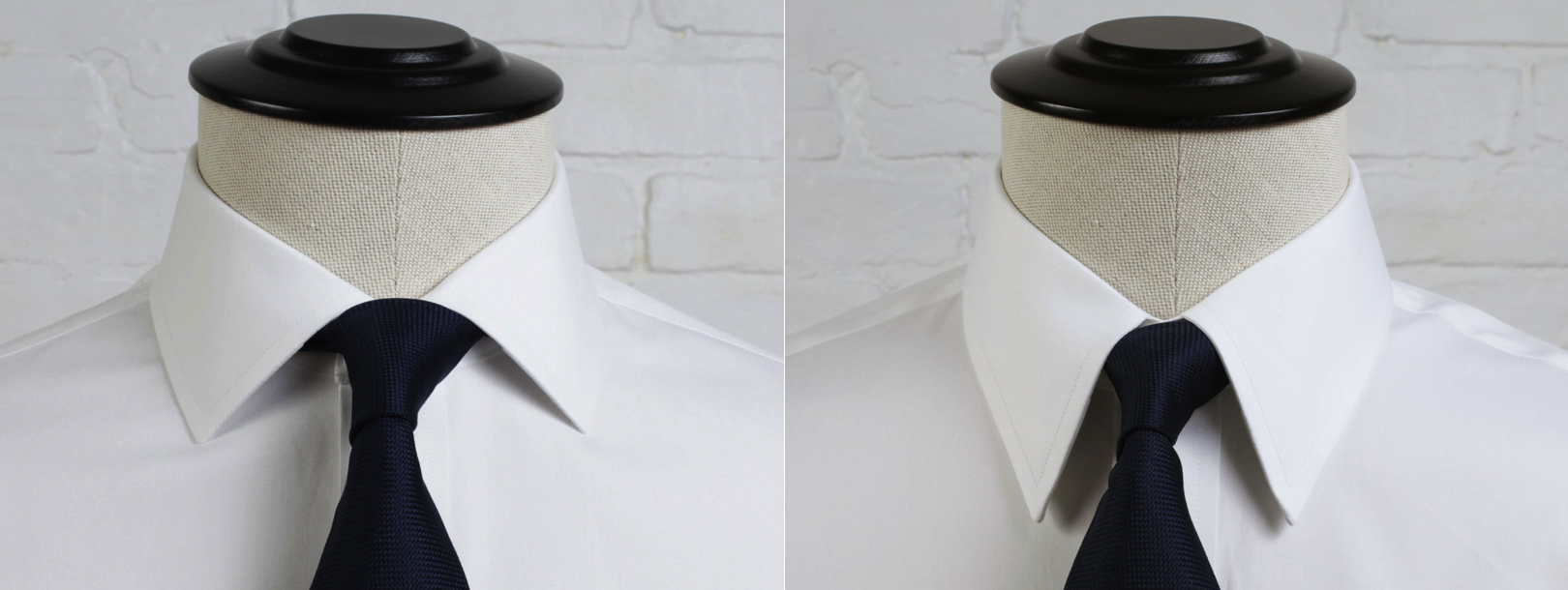
Left: Spread Collar Right: Point Collar

Spread Collar vs Point Collar

The spread collar and point collar are two of the most popular collar styles–the former being a little more modern, while the latter leans more classic. While the collar points on these two are exactly the same in length, the points end up 5” away from one another on the spread whereas they finish much closer, 3″ apart, on the point.

The effect is that the spread collar can visually widen the wearer’s face, while the point collar has been said to make one’s face appear longer (often quoted by Alan Flusser). The spread collar also allows more room for a wider tie knot than the point collar, due to the extra space between the collar points.

Cutaway Collar vs Spread Collar

cutaway versus spread collar

President Cutaway Collar vs. English Spread Collar

Cutaway Collar vs Spread Collar

For a bolder look, one might want to consider a cutaway collar in addition to the more popular spread collar. On the cutaway, the collar points will finish even farther apart (6 3/8″ to be exact, on the President Cutaway pictured above) than the spread collar.

Due to the extreme angle, cutaway collars make more of a statement than spread collars. Generally, spread collars are a safer choice if you’re working in a traditional office environment.

President Spread Collar vs Londoner Collar

president spread vs londoner

Difference between the President Spread and Londoner Collar

The President Spread is less spread than the Londoner collar and a little bit taller at the front collar band as well as at the back of the collar and it also has slightly longer point lengths.  The President Spread wouldn’t be considered a “Cutaway” collar, but the Londoner collar would.

The larger size of the President collar makes it a great fit for a larger man, or for someone that just wants a slightly larger, more prominent collar.  You might consider the larger size of the President collars a bit more British than American.  The Londoner collar is a sharp collar that is perfect for the man who wants the cutaway European look without being too extreme.