2025 Menswear Trends: The Modern Man’s Style Guide

Being on trend feels great; being ahead of it even better. We can’t predict the future, but we have a pulse on 2025 menswear trends, what guys wear, and where the industry is headed. So, here’s a list of 10 trends we think you’ll see in 2025 — some for the first time, others as continuations of things that are already hot. 

Before we jump in, if you’re in need of advice for summer nuptials, check out our guide on what to wear to a Summer Wedding in 2025.

1. Relaxed Tailoring: Comfort Meets Sophistication

TL;DR – Tailoring is moving back toward a more relaxed silhouette. Soft, unstructured blazers and wider fits dominate the scene, offering a modern take on suits, jackets, and dress pants. 

  • Wide-Leg Trousers: After a decade-plus of tight, heavily tapered pants, the pendulum of fashion is finally swinging back in the other direction. Pant legs are getting wider and fuller while exhibiting more break at the bottom. We are exiting the era of athletes and reality show contestants rocking skin-tight pants that show more ankle than an English schoolboy’s short pants. There’s no right or wrong or better or worse when it comes to the fullness of pants, but wide-leg trousers with more break create or drape and provide an interesting silhouette. For inspo, check out Richard Gere’s 90s Armani looks. 
  • Soft Blazers: Similarly, suit jackets, blazers, and sports coats are also headed in a more relaxed direction. Unstructured jackets, especially those made of breathable materials, are gaining popularity. The lighter nature of a jacket like this has always been widespread in warmer climates or as vacation pieces. Still, as guys try to achieve a look of relaxed elegance, you may see this type of jacket in more settings, blurring the lines between professional wear and leisure. 

Style Tip: You can create contrast in an outfit with wider-legged trousers and a more fitted top, like a knitted polo to go with your flowy pants. 

2. Textured Fabrics: Adding Depth and Interest

TL;DR – Throughout the 20-teens, there was a move toward sheen, glossy, non-wrinkle athleisure fabrics; now, the trend is going the opposite way as people look to have textures stand out. 

  • Corduroy: Corduroy has always enjoyed popularity in the Ivy/Prep world. But with a renewed interest in texture, expect to see more corduroy pants and shirts. 
  • Brushed Cotton: Another cool texture, brushed cotton offers softness and warmth, perfect for transitional weather.
  • Textured Knits: Subtle knits with raised patterns or unexpected can weaves add dimension to everyday essentials like sweaters and polos. Wider open weaves give off elegant nonchalance and breathe well poolside. 

Style Tip: Pair textured pieces with smoother fabrics to keep your outfit balanced and intentional.

3. Monochromatic Palettes: The Art of Tonal Dressing

TL;DR – Monochromatic outfits will be in with those looking to make a deliberate choice to dress in an elevated style.

Another 2025 menswear trend is the use of earth tones and navies to create timeless looks that can be mixed and matched seamlessly. Because you’re not using contrast with color, you can add texture to introduce visual intrigue beyond a single color. 

Style Tip: Neutral colors like beige, olive, and charcoal offer the most versatility for tonal dressing.

4. Understated Elegance: Moving Beyond Loud Luxury

TL;DR – Some roll their eyes at the term “quiet luxury” while others celebrate an intentionally understated style — no matter which camp you fall into, don’t expect to see less of it in 2025. 

Loud branding and ostentatious status symbols remain on the outs, replaced by an emphasis on high-quality, timeless pieces. Men are focusing on garments that emphasize craftsmanship, fit, and subtle elegance. If this is your vibe: 

  • focus on custom-fit essentials like dress shirts, trousers, and blazers in premium fabrics
  • incorporate understated design details, like subtle stitching or minimalist buttons

Style Tip: If you’re ready to invest in quiet luxury, you can make your money go even further with an excellent fit by going for custom. 

5. 70s Influences: Retro With a Modern Twist

TL;DR – The 70s are back (again), keeping the best of what worked and throwing out the rest. 

  • Wide Collars: You’re more likely to see this on celebrities first before it becomes more mainstream, but the red carpet has highlighted the return of bold, pointed, wide collars, especially paired with unstructured blazers.
  • Rich Colors and Patterns: Can’t guarantee we’ll get back to paisley, but you may see more warm tones like mustard, burgundy, and burnt orange paired with psychedelic-inspired patterns. 
  • Pants with Flare: A step shy of bellbottoms, pants with flared legs are back to give trousers a dramatic finish. 

Style Tip: If adding a retro feel to your look, start with one item first. Adding too many retro pieces simultaneously runs the risk of looking more like a costume than an outfit. 

6. 90s Influences: Relaxed and Cool

  • Oversized Shirts: Loose-fitting shirts in soft, breathable fabrics add a laid-back vibe to casual looks that feel like they’re pulled from the wardrobe design of Twin Peaks, incorporating the best elements of both a woodsy and grunge aesthetic. 
  • Relaxed Denim: Straight and wide-leg pants and denim western shirts offer nods to 90s nostalgia. 

Style Tip: If you’re new to this, balance oversized pieces to avoid looking sloppy.

7. Cowboy Boots Go Mainstream

TL;DR – Cowboy boots are getting more attention in the mainstream, occasionally paired with refined tailoring for an unexpected contrast. 

As an absolutely iconic piece of American fashion, it might seem preposterous to suggest that cowboy boots are somehow “back.” We recognize that, but we’d argue that 10 years ago, you’d be hard-pressed to see these in many big cities or college campuses outside certain pockets. Now, you will. 

Style Tip: If you’re going for versatile, start with a subtle, minimalist designs in a neutral tone.

8. More Loafers, Fewer Sneakers?

TL;DR – While sneakers remain a wardrobe staple, loafers are emerging as the footwear of choice for men seeking refinement that’s still easy. 

For the last few years, the internet has been ablaze with young people talking about “old money” aesthetics. Ivy or Northeastern prep style feels like a small sub-genre of that somewhat hard-to-define-or-agree-upon overall trend. With that ivy prep look comes the penny loafers and occasionally tassel loafers, but you’ll also see loafers integrated into new genres of subcultures of style.

Style Tip: Once seen as stodgy, loafers are now treated like casual slip-on shoes, so try incorporating these with relaxed looks. 

9. The Return of Undershirts

TL;DR – The visible undershirt is back, which feels reminiscent of the 90s trying to feel like the 50s – there’s layers to it.  

And speaking of layers, this makes for a great staple in a layering strategy. Look for high-quality undershirts in breathable fabrics like cotton or modal. 

Style Tip: If you’re trying to achieve that sexy nonchalance, opt for slimmer fits to prevent bulk under shirts.

10. Accessories: Small Details, Big Impact

TL;DR – Guys are taking looks up a notch with accent details as our final 2025 menswear trend.

  • Scarves: Lightweight scarves in textured fabrics like cashmere or wool can elevate a more tailored look, while a silk scarf gives a European flare to a warm-weather look. 
  • Statement Belts: This might feel like it’s at the opposite end of the stealth-wealth look, and maybe it is. But there’s also a space to play that’s somewhere between a huge and gaudy logo and being so subtle it goes unnoticed. 
  • Accent Jewelry: Through various periods of style, gentlemen have been deprived of adding a flourish with jewelry, but your wedding ring doesn’t have to be the only bit. Rings and minimalist necklaces add a refined touch without overwhelming the outfit.

Style Tip: Pick out your shirt, pants, and shoes. Then, look at your accessories and think about what will complement the outfit and where you might draw the eye. 

Looking for more style advice beyond 2025 menswear trends? Check out our reference page with hundreds of articles about style, fit, and garment care. If you want to talk to someone about custom clothing, you can chat, call, or visit a showroom.

A Comprehensive Guide to Raw Denim: Features, Care, and How to Make It Last

Raw denim is a beloved choice for denim enthusiasts due to its unique, customizable aging process and durability. Unlike most denim on the market, raw denim is untreated, unwashed, and made from high-quality cotton fibers. It holds the promise of a personalized fit and look that develops over time with proper care. This article provides insights on how to care for raw denim, what makes it different from pre-washed denim, and why it’s worth the investment.

What is Raw Denim?

Raw denim, also referred to as “dry” or “unwashed” denim, is fabric that has not undergone any washes or treatments after being dyed. This gives it a stiff, rigid feel when first purchased, and it retains its natural indigo color until it is worn and washed over time. The appeal of raw denim lies in the fact that it allows wearers to create a pair of jeans that molds to their body shape, developing unique fades, creases, and wear patterns.

Understanding the Difference: Raw Denim vs. Pre-Washed Denim

The primary difference between raw denim and pre-washed denim lies in the finishing process:

  • Raw Denim: As mentioned, raw denim is untreated, maintaining its natural, undisturbed state. It’s stiffer and darker at first but offers a unique, customizable aging process.
  • Pre-Washed Denim: This denim has undergone a washing process to soften the fabric, give it a worn-in look, and prevent shrinkage. Pre-washed denim is generally more comfortable from the start but lacks the ability to develop personalized fades and wear patterns.

Characteristics of Raw Denim

Raw denim is usually woven with a tight weave, which makes the fabric stronger and more durable compared to denim that has been pre-washed. The raw state allows it to “break in” with use, resulting in a personalized, unique pair of jeans that reflects the wearer’s lifestyle and habits.

Types of Raw Denim

Raw denim comes in a variety of weights, typically measured in ounces per square yard (oz), ranging from light to heavy-duty. The weight affects how stiff the denim feels and how it will break in over time. Lighter denims are often more breathable, while heavier ones are more durable and are preferred by those looking for a long-lasting, rugged pair of jeans.

Why Choose Raw Denim?

Customization of Fades and Patina

One of the main draws of raw denim is the ability to develop unique fades that reflect the wearer’s daily activities. As you wear raw denim, the indigo dye gradually fades in areas where the fabric is subjected to friction, such as the thighs, knees, and seat. This personal “wear pattern” creates a one-of-a-kind look.

Durability

Raw denim tends to be sturdier than pre-washed denim. The fabric is typically denser and less susceptible to stretching, shrinking, or fraying, meaning it can last longer with proper care. Over time, the raw material softens but retains its strength.

The Raw Denim Break-In Process

Wearing raw denim is a process, and how long it takes to “break in” will vary based on the weight and style of the fabric. During the break-in period, raw denim can feel stiff and uncomfortable, but as the fibers soften, the fit becomes more customized. The jeans will begin to mold to your body, and the denim will develop natural creases and fades. Here are a few tips for the break-in process:

  • Wear Regularly: To speed up the process and help the denim conform to your body, wear the jeans as often as possible.
  • Be Patient: Raw denim is not designed to be comfortable from the start. Expect the first few weeks to feel rigid and stiff. 
  • Avoid Over-Washing: Frequent washing can hinder the aging process. The more you wear and let the denim’s fade develop naturally, the better the result.

Caring for Raw Denim

Raw denim is a commitment, but with proper care, it can age beautifully. Here are some essential tips for maintaining your raw denim jeans and ensuring they last for years:

1. Avoid Washing Too Soon

It’s crucial to resist the urge to wash raw denim right away. The first wash should ideally come after 6 months of wear, as this allows the denim to form natural creases and fades. Washing too early can disrupt the aging process and diminish the unique characteristics of the fabric. However, this timeline can vary depending on personal preferences and usage. 

2. Spot Cleaning

Instead of washing your raw denim frequently, consider spot cleaning with a damp cloth. Use a mild detergent when necessary and avoid soaking the jeans in water. This helps prevent shrinkage and fading before the fabric has fully broken in.

3. Freezing to Remove Odors

One popular method for freshening up raw denim without washing it is freezing. Simply place the jeans in a plastic bag and put them in the freezer for a few hours. This kills bacteria that cause odors while avoiding the wear and tear of frequent washing.

4. Washing Process

When it’s time for a wash, turn your denim inside out to preserve the indigo dye and reduce fading. It is critical that you use cold water to wash raw denim to eliminate the risk of shrinkage. Use a gentle detergent designed for denim, and air-dry the jeans by laying them flat. This will preserve their raw, stiff feel.

5. Stretching and Shrinking

Raw denim can shrink slightly after the first few washes, so be prepared for a snug fit at first. To combat this, you can stretch the jeans while damp, pulling on them to achieve your desired fit. Some denim enthusiasts recommend soaking raw denim in lukewarm water before wearing them to minimize shrinkage.

6. Drying and Storage

Always air-dry your raw denim to preserve its structure and color. Direct sunlight can fade the fabric, so hang your jeans in a shaded, well-ventilated area. To prevent stretching and sagging, it’s important to hang them by the waistband or cuffs rather than by the legs.

Conclusion

Raw denim is a unique and durable choice for those who appreciate high-quality materials and craftsmanship. While it requires patience and commitment to care, the results—unique fades, a personalized fit, and long-lasting durability—make it worth the effort. By following the right care practices and embracing the natural aging process, raw denim can become a truly cherished wardrobe staple. Whether you’re a seasoned denim enthusiast or a newcomer looking to invest in a quality pair of jeans, raw denim offers a rewarding experience that evolves with you over time.

The Ultimate Guide to Custom-Fit Dress Shirts: Why Fit Matters

Whether you’re tired of shirts that don’t fit right or just looking to up your appearance, the obvious starting point is graduating from off-the-rack options to custom-fit dress shirts.

The Problem with Off-the-Rack Shirts

Sure, off-the-rack fits some gents. But for the rest of us, small, medium, and large options don’t cut it. Adding in a sleeve and neck sizing doesn’t offer much sizing range.

  • Poor Sizing Options: Standard sizes rarely consider torso and arm length or shoulder and chest width, forcing guys into choosing from standard sizes that don’t match their measurements.
  • Standardized Construction: Mass-produced shirts aim to create a size that will fit most, like a boxy, unflattering shape aimed at “the average guy” but doesn’t fit most. Additionally, off-the-rack often chases trends that may not reflect your taste, like trying to put everyone in a super slim-fit shirt.
  • Inconsistencies Across Brands: Small, medium, and large may vary widely across brands, creating an unpredictable sizing experience.

Why Fit Matters in Dress Shirts

  • Flattering Appearance: A dress shirt made to your measurements and your style preferences creates a clean, sharp silhouette that flatters.
  • All-Day Comfort: Rather than forcing your way into a shirt that’s too small or fighting the extra fabric of a shirt that’s too large, custom-fit dress shirts have the right amount of room and give, keeping you comfortable.
  • Confidence Boost: A made-to-measure shirt looks and feels better, giving you a little extra self-assurance in the morning.

Key Areas of Fit

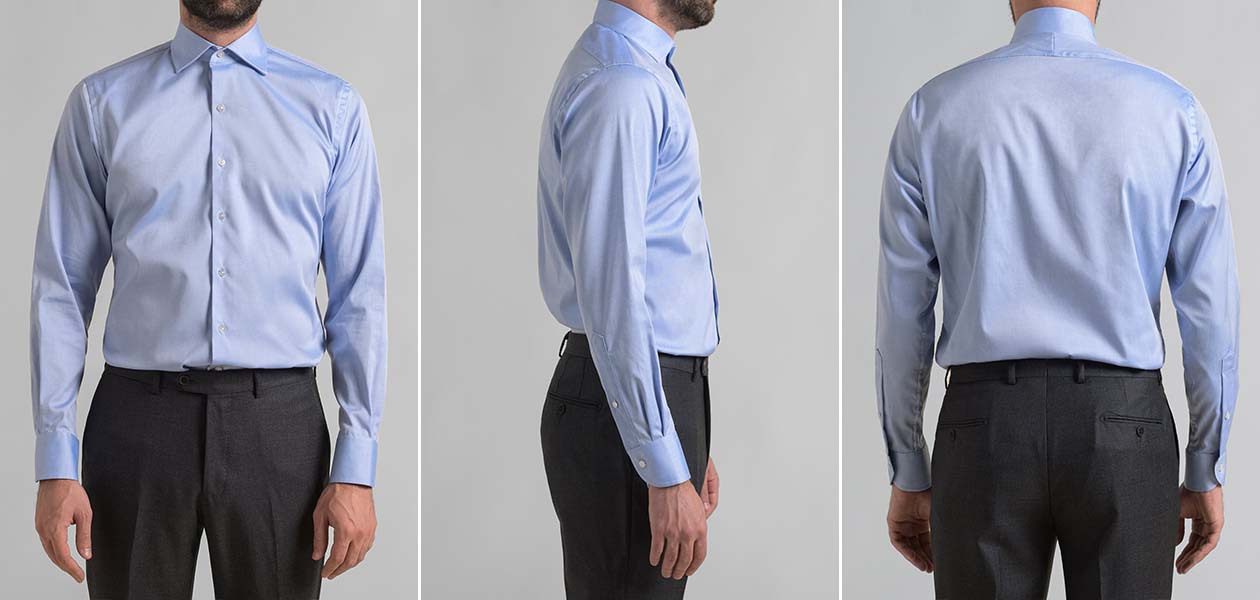
  • Collar: Should fit snugly but allow room for two fingers.
  • Shoulders: Seams should sit at the edge of your shoulders.
  • Chest & Waist: Tailored, but not tight, to provide shape without restriction.
  • Sleeves: Cuffs should stop before your hands and be easy to button without being loose.
  • Length: Long enough to tuck in comfortably without easily slipping out throughout the day.

The Benefits of Custom-Fit Shirts

  • Perfect Fit for Every Body Type: Custom-fit dress shirts don’t require sacrifice. A shirt made to your unique measurements guarantees a flattering fit.
  • Premium Fabrics: Rather than accepting the colors, patterns, and materials a company offers, custom allows you to select high-quality materials based on texture, weight, style, patterns, and colors.
  • Personalization Options: A good shirtmaker allows you to select essential details.
  • Durability and Long-Term Value: Custom usually costs more upfront, but higher-quality materials are more durable, allowing the shirt to last longer.
  • Sustainability: Custom means made when there’s demand, avoiding unsold products. Better materials will last longer and not require a replacement as soon.

The Proper Cloth Process

  • Easy Online Sizing: Most customers start with Proper Cloth’s Smart Size Quiz, an algorithm based on thousands of data points. Other ways to create a size include measuring a shirt, mailing a shirt, measuring your body, or visiting a showroom.
  • Fabric Selection: Once you know your size, you can choose from a massive library of fabrics, ranging from material to weight to style.
  • Style Personalization: Put your stamp on your dress shirt by choosing the style of your cuffs, collar, hem, pockets, and more.
  • Saved Profiles: After you create a size, you can order new shirts in your existing size or create new profiles for different styles.
  • Fast Delivery: Proper Cloth usually has your new custom-fit shirts at your door in under two weeks.
  • Real Customer Services: We offer free remakes and free returns. We also have a variety of ways to get in touch with customer service, including speaking with a real person on the phone.

Design Your Custom Shirt Today

If you’re ready to elevate your wardrobe with custom-fit dress shirts, you can get started by creating a size. With a fit guarantee, free returns and remakes, a library of fabrics, and customization options, Proper Cloth is an easy, risk-free, and sophisticated way to take your style up a notch.

Want to hear the hype from someone else? Check out our recent write-up in The New York Times Wirecutter.

Your Primer for Corduroy

Corduroy is an enigmatic fabric, dancing gracefully between casual and sophisticated looks. Sometimes, the material presents as rugged; at others, the velvety soft feel formed an aristocratic association – (more on that later). The dynamic and complex textile has taken its place in many wardrobes over the years. To decide if has a place in yours, read on.

What is Corduroy?

Corduroy isn’t a material but rather a fabric treatment, referring to a weave or texture. It is characterized by its raised ridges called “wales” that run parallel to the surface. Generally, it comes from cotton and cotton blends, although the weave and texture can be created through other fabrics like wool or velveteen.

The History of this Iconic Fabric

A corduroy-like fabric called “fustian” first appeared in ancient Egypt, where it was used for furnishings and clothing. Corduroy, as we know it, was originally used as workwear because of its toughness. Some claim that the fabric has a connection to royalty, with the name coming from the French “Corde du roi,” meaning cord of the king, although the fabric was predominantly used by laborers, making it unlikely that it was ever the fabric of nobility.

It was in the 20th century that this fabric transitioned from the commoner’s workwear to a fashion statement. It began to show up in the affluent East Coast preppy look. Eventually, counterculture movements reclaimed the style in the 1960s and 70s. Today, corduroy doesn’t have a strong association with any particular subculture. Because of its warmth and cozy feeling, the fabric is popular as a fall and winter look worn by many.

Why Choose Corduroy?

Corduroy offers true versatility. Styled right, it can give off a cowboy or utilitarian vibe. You can dress it up for a cozy, classy aesthetic. The heavier weave and weight make it a warm fabric, perfect for fall and winter. High-quality corduroy is also durable and should last many seasons.

How to Style Corduroy

This versatile fabric can carry a lot of looks. Here are a few different pieces of clothing and how we recommend styling them.

Shirts

The corduroy shirt is a great place to experiment with the garment’s more rugged side. In Americana style, the shirt is often associated with a cowboy or California aesthetic of the 50s and 60s. Worn untucked with jeans or five-pocket pants; it gives the relaxed confidence of that rancher archetype. Proper Cloth has a few Western-style corduroy shirts with a Western yoke, patch pockets, and snap buttons. But corduroy looks great in any style, so you can always customize the placket, collar style, buttons, and cuffs to put your own spin on this iconic fabric.

Pants

Corduroy pants are incredibly versatile, leaving the door wide open to styling. For a casual look, you can wear these pants instead of your chinos, so consider a tucked or untucked shirt like an oxford. You can add contrast by choosing a patterned shirt like a plaid. A sweater over a collared shirt and even a tie gives off a classic prep look. A deep red or green pair with a turtleneck looks fitting for something festive. To up it another level, try layering a sports coat over it. Proper Cloth offers a stretch-fit chino style and a dress pant version.

Jackets & Suits

This iconic fabric also makes for an excellent jacket material. Depending on how it’s styled, it can give off a professorial-academic look or a fashion-forward luxurious style appropriate for holiday parties. A stand-alone jacket looks great with a denim or chambray shirt, an OCBD, or a classic dress shirt. Give it a relaxed feel with jeans or chinos. It’s also a bold statement choice for a suit. Since it’s considered much less formal than other suit fabrics, skip the tie and find a dress shirt that complements the corduroy’s color.

Caring for Corduroy

Good quality men’s custom corduroy clothing should require little maintenance. To maintain your corduroy’s rich color:

  • Wash Sparingly: Don’t overwash the garment. Spot treat. If you wash, use cold and gentle settings.
  • Hang Dry: Avoid shrinking and heat damage by hang drying or flat laying.
  • Brush the Fabric: Brush the fabric to prevent lint build-up, but do this in moderation so as not to wear out the wales.
  • Consult the Tag: With any garment you love, check the interior tag for specific care instructions.

That said, some people prefer the faded, worn corduroy look. If you’re in that category, you can be less precious with it.

Why Proper Cloth for Corduroy?

When it comes to custom corduroy clothing for men, Proper Cloth does it right. We sourced primarily from the renowned mill Duca Visconti, located just outside of Milan, Italy. This mill has specialized in velvets, moleskins, and corduroys for nearly 200 years.

Custom Corduroy Clothing for Men

With a focus on size, custom corduroy shirts, tailored jackets, and made-to-measure pants look cleaner, accentuating the fabric’s bold characteristics. The ability to customize a shirt’s construction or suit’s details gives you nearly limitless options to explore.

For inspo on corduroy and so much more, check out our friends over at Die Workwear for a mix of casual and formal looks.

Cold Weather Must-Haves: Custom Outerwear and Cashmere Sweaters

It’s cold outside — and depending on how your partner likes the house — it’s possibly cold inside. Now’s the time to revamp your look with some cold-weather must-haves, so you can stay cozy without sacrificing style. Here’s a guide to curating winter wardrobe essentials.

The Foundation of Winter Style: Cashmere Layers

Luxury Cashmere Sweaters

With its soft texture and silky touch, cashmere provides incredible comfort. Proper Cloth’s luxury cashmere sweaters collection uses 100% cashmere, sourced from nomadic Mongolian farmers and spun from the legendary Todd & Duncan mill in Scotland. Proper Cloth offers a broad range of cashmere sweater styles. It’s easy to find something for a casual look, like a hoodie, or something to dress up, like a half-zip.

Custom-Fit Tailored Winter Clothing

Winter outfits can often be bulky. Proper Cloth’s custom-fit cashmere and wool jackets fit to your exact measurements, creating a flattering silhouette. Not only can you have these made to your measurements, but customization allows you great control over shape, drape, sleeve-length, buttons, pocket flaps, and other refined details.

Essential Outerwear for Every Occasion

Your coat or jacket sets the tone of an outfit, finishing a look while providing warmth.

Tailored Overcoats

An overcoat creates a classic silhouette and looks natural over a suit. But done well, it can easily dress up a more casual look, making it an essential part of a winter wardrobe. If you’re in the market for cashmere, The Bleecker Coat has a sharp, tailored shoulder for a formal look while providing the soft comfort that the fabric is known for. The Crosby Belted Coat has a raglan shoulder, made famous by tailors in the British Isles, and a belt to create shape and form in the middle.

Shirt Jackets and Overshirts

When it comes to lighter options, Proper Cloth has a range of options for casual options that are perfect winter layers for men.

The Overshirt: A casual layer that combines elements of a shirt and jacket, usually made from heavier fabrics with flap pockets for utility, available in a soft 100% merino wool.

The Shirt Jacket: An option that follows jacket styling which can serve as a sport coat alternative, providing structure with a more utilitarian style.

The Chore Coat: Derived from a more 19th century, blue collar work garment, this offers functional style with a boxy silhouette.

Luxury Vests

When it comes to winter layers for men, a vest offers an outer layer for early spring and fall or extra insulation as a base for colder months. A sophisticated vest is a great item to keep at desk for colder days in the office.

Merino Wool Vests

Merino wool vests provide comfort and style in a breathable material. Proper Cloth offers a few variations, all made from 100% Merino Wool from the legendary Reda mill.

The Cortina Button Vest

If you’re really looking to make a statement, a goat suede vest is a head-turner and perfect for that upscale ski resort or ranch vacation.

Build Warmth with Winter Layers

Layering creates warmth and creates outfit flexibility. When you’re putting it all together, consider three layers.

Base Layer: Start with a custom-fitted dress shirt, designed to wick moisture and provide a sleek foundation.

Mid-Layer: Add a cashmere or wool sweater or a vest for breathable insulation.

Outer Layer: Top off your look with a tailored coat, jacket, or sports coat that complements your outfit and fits the occasion.

Making “Must-Have” Personal

Building a winter wardrobe doesn’t have to involve a massive overhaul. We think of “must-haves” as something personal, something you can’t live without, rather than assuming every guy has to own a certain set of pieces. So, your “cold-weather must-haves” will vary greatly depending on your taste and lifestyle. Have some fun with figuring out which pieces are irreplaceable to you.

If you’re ever looking for style advice Die Workwear and Ape to Gentleman both have great articles for all different styles and tastes.

What to Wear for Business Casual: Tips and Custom Options

If you’re wondering what to wear for business casual, you’re not alone. Nailing business casual attire can be challenging because it can mean different things in different workplaces. In short, you’re trying to convey relaxed professionalism. A short list might look something like this:

  • Collared shirts (dress shirts, casual shirts with collars, and polos),
  • Professional pants (chinos, khakis, dress pants, and occasionally performance pants)
  • Semi-formal shoes (oxfords, derbies, and loafers, and occasionally hybrid dress shoes or sneakers)

While a short list can be helpful, there is nuance to nailing men’s business casual. So, here are some business casual tips for what to wear.

How to Build a Business Casual Wardrobe

Aim for Versatility

Buy items that are easy to pair. For shirts, solid colors or muted patterns are a smart starting point. For pants, navy, grey, and tan or khaki colors provide a base that is easy to complement without overthinking it.

Classic Dress Shirts

To start, you want a few of the basics. We recommend a white dress shirt as a base because it looks good with just about everything. A Non-Iron Shirt requires little care and will look polished throughout the day. If you’re ready to experiment with color, we recommend light blue or shirts with subtle blue and white patterns like The Stanton. As you grow your wardrobe, you can introduce more understated patterns like tattersall, gingham, multi-checks, and houndstooth.

Classic Casual Shirts

If you’re looking for more relaxed options than dress shirts, a great place to start is The Oxford. This shirt, often called the “OCBD” (more on that here), straddles the line between professional and casual. Like a dress shirt, you can never go wrong with white and blue, but soft pastel Oxfords also work.

Knit Dress Shirts

Knit-dress shirts are professional yet comfortable. If you’re looking for a relaxed feel with some give to move around, shirts like The Performance Knit Pique Dress Shirt will feel like you’re in your favorite around-the-house attire while cueing a dressed-up look.

Classic Dress Pants

Dress pants signal professionalism. They look best with a dress shirt but are versatile enough to pair with casual shirts or a high-end polo. An option like The Versa Stretch Dress Pant comes in various colors, is machine washable, and has stretch material for maximum comfort.

Chinos & Khakis: The Casual Pant

Chinos and khakis are both staples of business casual looks. Chinos are made from lightweight, fine-woven fabric and are appropriate for a semi-formal occasion. Khakis are usually heavier fabrics made from denser weave and are considered slightly less formal. Since business casual encompasses a range of definitions and degrees of formality, it’s worth looking around your office to see if anyone is wearing khakis. A Non-Iron Stretch Chino will look great with a dress shirt, belt, or casual shirt.

Performance Chinos for Office

Performance pants, which generally refer to pants with stretch-fit or athletic materials added, can work for business casual, but a note of caution here. It’s best to look for performance pants that look like dress pants or chinos. If you lean too far into athletic wear, it can start to look unprofessional. The Sandpiper Chino is an excellent substitute for a chino in a casual setting.

Layers & Shoes

To dress it up, incorporate a blazer or sport coat. Custom-made sport coats provide a tailored fit that complements a made-to-measure shirt perfectly. For casual days, sweaters and vests give an outfit more depth while providing some functional warmth.

For shoes, you can’t go wrong with oxfords and derbys or a handsome pair of loafers. In some business casual offices, you’ll see hybrid dress shoes. Those are shoes where the top looks like a dress shoe and the sole looks more like a sneaker. Again, getting a feel for the unspoken rules before breaking them out is a good idea.

Custom Fits Better for Business Casual

Whatever fabric or level of formality you opt for, fit is essential. Excess fabric ends up looking baggy and sloppy. Items that are too small can look boyish and even be restrictive throughout the day. Custom dress shirts and pants look more refined – even subconsciously – to people who don’t think much about style or fit. It isn’t just the dressier items; custom business casual shirts look better, especially if worn untucked.

A more intentional look can set you apart in a professional setting. Custom doesn’t have to be difficult, either. We’ve spent years perfecting our user-friendly Smart Size algorithm to create your custom fit online so you can confidently walk through the office doors with confidence in your business casual style.

The Ultimate Guide to Cashmere Sweaters for Men: History, Styling, and Care

Cashmere sweaters are prized for their incredible softness, comfort, and elegant look. This combination of comfort and style has turned a fabric traditionally from rural Central Asia into a cosmopolitan luxury good.

What Sets Cashmere Apart?

Cashmere is considered a type of wool. Unlike regular wool, usually taken from sheep, cashmere comes from cashmere goats. The best material comes from the softer undercoat. Shearing and separating the finest materials is time-consuming, contributing to the fabric’s higher price.

What to Look for in Cashmere

The softness of cashmere is determined by something called “microns,” a unit of measurement used to describe the fineness. The lower the number of microns, the better the quality of the cashmere. Grade A cashmere has 14-16 microns. Proper Cloth uses a super-fine 15-micron thickness in our cashmere.

Proper Cloth’s Cashmere

Proper Cloth offers an incredible range of cashmere sweaters, but they’re all connected by the cashmere. The entire collection is 100% cashmere from the legendary Scottish mill Todd & Duncan. Sourced sustainably from nomadic Mongolian farmers, we exclusively use the ultra-fine, ultra-soft 15-micron thickness.

Cashmere Sweater Styles

Cashmere Crewneck Sweater

The Cashmere Crew is a classic staple. It’s incredibly versatile, pairing well with sneakers and jeans as easily as it pairs with a sport coat and loafers, and It looks elegant over a dress shirt for those colder days in the office.

Cashmere V-Neck Sweater

Some people have strong opinions on the v-neck (a funny opinion piece from Vogue on the topic). We’re fans. The neck opening creates an elegant line that looks great alone, with a t-shirt underneath or with a dress shirt. Like its crewneck cousin, Proper Cloth’s V-Neck Sweater is easy to dress up or wear casually.

Cashmere Full-Zip Sweater

The full-zip offers a sportier design and some underrated ease. If you spend time on your hair in the morning, the full-zip allows you to add or subtract a layer throughout the day as your temperature changes without having to reach for a brush again. The full-zip looks great with jeans and layered over a t-shirt or dressed up over a buttoned shirt. Because you can zip it all the way up or down, you can adjust your look within a single outfit.

Cashmere Half-Zip Sweater

Proper Cloth’s cashmere half-zip provides a balance between athletic and luxurious looks. The half-zip (called a quarter-zip by some brands) gives a relaxed and casual vibe, while the cashmere material and craftsmanship suggest luxury. The look leans a little more casual, so sneakers, jeans, chinos, and polos all go well. That said, you can wear it under a sport coat or even with a suit and tie.


Cashmere Turtleneck Sweater

The dynamism of the turtleneck cannot be understated. The soft material and high neck create an incredible coziness, suggesting a more relaxed personal garment. At the same time, turtlenecks can look very sophisticated, especially when worn under a sport coat or with a full suit. Proper Cloth’s Cashmere Turtleneck Sweater looks great tucked into chinos, untucked with jeans, or worn with a suit for a holiday party.

Cashmere Hoodie

A hoodie is not something you often see in the cashmere sweater category. However, cashmere is such an incredibly soft material, and since the hoodie provides full coverage and warmth, pairing the material with the sweater style made sense. The unique cashmere silhouette looks great with leisure wear like drawstring pants, but you can also style it with chinos or even dress pants for an unexpected look.

Caring for Cashmere Sweaters

Dry Cleaning Cashmere Sweaters

You can dry-clean cashmere sweaters. But, it’s best to do this sparingly because they are made from delicate materials, and dry cleaning uses powerful chemicals. If you take it to the dry cleaner, it’s worth mentioning to the cleaner that the material is cashmere.

Washing Your Cashmere Sweaters at Home

Cleaning at home is a safe and less expensive alternative to the dry cleaner. You can hand wash them or use your washing machine’s “delicates” setting. Explore using a delicate detergent on sweaters and knits. Use cold water and lay it flat to air dry. It’s good to reshape the garment as it dries to maintain the structure. You can learn more about caring for all Proper Cloth garments here.

Storing Cashmere Sweaters

We tend to think of nicer garments getting a hanger while less fancy clothing goes in drawers. With sweaters, it’s best to fold them to avoid the weight of the sweater stretching out the shoulders and neck. You can give your cashmere sweaters extra protection by storing them in air-tight bags or plastic bins during warmer months to keep out smells, moths, and general wear.

If you have questions on styling or care, we’re always here to answer questions. If you’re looking for knits and sweaters beyond cashmere, check out our full collection which also includes silk, linen, wool, and unique blends.

The Double Breasted Suit: A History & Resurgence

Once seen as your rigid uncle’s tailoring, the DB is back. Here’s a quick history of the sometimes down but never-fully-out double-breasted suit. 

What Makes it a Double Breasted Suit?

The double breasted suit is made of overlapping jacket breasts, decorative buttons, and a peak lapel. 

The defining feature of the double-breasted suit is the left jacket breast overlaps the right, covering part of it. The suit jacket has two rows of buttons, most commonly six (three on each side) or four (two on each side); occasionally, you’ll see just two buttons on garments like smoking jackets. Despite having many buttons, the jacket is most commonly closed with two. One is on the exterior, and the other is on the internal, known as an anchor button, making most of the buttons on the jacket ornamental. Lastly, a double-breasted suit usually has peak labels. Where portion where the neck part of the lapel and the chest part of the lapel meet, the chest portion jets out past the neck portion, creating a “peak.” 

The Early Days: A Double Breasted Origin Story 

This suit was born from British Naval attire and gained popularity through royalty and celebrities. 

Like so many things in tailoring, the double-breasted suit comes to us from Great Britain. The first double-breasted jackets were modeled after the peacoat worn by the British Navy and were called “the naval reefer jacket.” 

The jacket was originally a sporting jacket worn while participating in or attending sporting events. While a jacket or sports coat at a football game feels stuffy today, the DB was initially seen as very informal and was occasionally looked down upon by traditionalists. 

The jacket first garnered attention as international interest in the British Royal Family grew. Prince Edward, the Duke Of Windsor, was a fan, bringing the style into the spotlight. The momentum continued as the jacket gained popularity in Hollywood’s Golden era, with the likes of  Burt Lancaster, Cary Grant, Humphrey Bogart, and Gary Cooper all sporting the double-breasted suits in famous movies and in their personal lives. 

Between royalty and celebrities, the suit started to garner an elitist association. The trend would continue through the Second World War when fabric shortages and textile costs meant that DBs were unattainable except for the wealthy. 

A Second Wind: The Revival of the DB 

After going out of fashion for a few decades, the double breasted suit made a comeback as the suit of spies, detectives, and day traders. 

And so it disappeared from runways and closest for a few decades until it was in vogue again in

the 1980s. Interest returned as they started to pop up in collections from Armani, becoming a staple on the culturally influential Miami Vice. In the show, Philip Michael Thomas’ character, Ricardo Tubbs, wears a looser, flowing version, often with a tie. While not solely responsible, it helped remove some of the association with the suit’s “stodgy” reputation, renewing interest.

Throughout the 80s and 90s, it became popular on Wall Street and in pop culture, making appearances on the likes of Pierce Brosnan in James Bond and Brad Pitt in Cool World. The 90s saw the suit reach its absurdly baggy and boxy apex.

Once again, popularity waned. Some factors may have contributed beyond the ebbs and flow of fashion trends. First, younger buyers came along and associated the suit with past generations — it was, again, your dad’s suit. However, how suits were made also changed, and true tailoring was fading while mass market production steamrolled forward. More than ever, suits were now made for off-the-rack shopping rather than by a tailor. Double-breasted suits cost more to produce and are more of a challenge to look nice without tailored adjustments. And so, once again, the double-breasted suit began to disappear from store windows and popular culture.

A Classic Is Back: The Double Breasted Jacket Is Back in Action 

The jacket has made a comeback with a bit more restraint. 

The suit was uncommon — at least in The United States — throughout the 2000s and 2010s. Luckily, it’s been making a comeback as of late. The exact reasons for the reemergence are harder to pin down; it could be the general cycling of trends or renewed interest from sartorial gentlemen who kept the suit alive in their niche communities. Whatever the reason, the current popularity rests in a perfect middle ground: uncommon enough for the wearer to stand out but not so unusual that it feels dated or gauche. 

As a company that appreciates sartorial elegance, we have always admired the suits. This fall, we’ve created three variations of our Bedford suit in a bold but not overly provocative design. Made for a warm but breathable 100% merino wool flannel for the iconic Vitale Barberis Canonico mill, the suit is warm enough for winter wear without overheating (a primer on cold weather fabrics here). This particular suit is available in a traditional navy, easy-to-pair grey, and an eye-catching chalkstripe. 

Whether you’re looking for a statement piece or finding a modern way to nod to eras past, the DB is an iconic piece that gentlemen have worn for decades. And if you’re ever worried about it going out of style, just remember it always makes a comeback. 

Note: The vast majority of Proper Cloth’s single breasted suits can be made into doubles through customization.

The Versatility of White Button-Up Shirts

People’s lifestyles, clothing preferences, and employer dress code (or lack thereof) vary wildly. So, there really aren’t many pieces of clothing that “every man should own.” The button-up shirt might be an exception. But that doesn’t mean that every person has to own the same standard white shirt. We explored different types of white dress shirts and how to style them to provide an option for a white button-up shirt for anyone.

First, if you’re on the hunt for a formal white shirt for a wedding or black tie event, here’s a quick guide to find the right shirt.

The Basics of Button-Up Shirts

When we reference the button-up shirt, we mean a formal, semi-formal, or casual shirt with buttons up the front. This is not to be confused with a “button-down” shirt, which refers to a collar style where the collar points are attached to the shirt. To give you a range of white shirts, we’ll discuss a wide variety of white shirts.

Keep It Classic

A white button-up dress shirt paired with men’s formal or business casual attire will always look good.

A traditional white dress shirt alongside a full suit or a jacket with dress trousers offers a timeless look for the office or a dressier wedding. The full suit and tie look great for the most buttoned-up version, but losing the tie suggests a relaxed elegance.

Go Jacket-less for Polished Ease

Wearing your white button-up shirts without a jacket gives a smart, but unstuffy look.

If you work in a casual office or at the end of a long day, let the white dress shirt have the spotlight. Tucked into dress pants, the elegant minimalism of a timeless white shirt shines through. It looks great with a leather belt, but you can double down on the clean look with side tabs and a luxurious twill fabric.

If you’re chasing a vacation look, unbutton a few more buttons and roll the sleeves. For that coastal vacation look, check out the Giro Inglese.

Add Button-Down to Your Button-Up

Button-down collars bring a casual prep style to your classic white button-down shirts.

This collar style, invented to keep a collar from moving around during sporting events, has long been associated with East Coast, Ivy League, and preppy styles. However, the style has become so popular that it’s now seen as more ubiquitous than belonging to any one subculture. If you’re chasing the old-school prep vibe, pair it with chinos and consider a sweater around the waist or neck. For a more casual look, try it untucked with jeans.

Explore Texture

Different fabric or fabric treatments create white button-up shirts that look and feel different.

Seersucker, a cotton that alternates tight and loose weaves, creates an eye-catching texture. Often associated with southern tailoring, the fabric also looks great as a casual white shirt. It looks great untucked with casual summer pants.

Another fabric famed for its texture is linen. Light and breathable, the material is often worn in warmer climates and associated with a vacation aesthetic. You’ll see it commonly worn untucked with light pants or even shorts. Worn as a standard button-up shirt, it can dressed up a little bit when tucked in or worn with a jacket. The fabric also looks great in the functional-oriented utility style, leaning way into the casual, almost practical style.

Finding the Right White Button-Up Shirt for You

While there’s no shirt every man must own, there is a white shirt for every man.

Defining your style and determining what clothes you want can be a process. Looking at inspiration (we like Inside Hook and Valet), trying things on, and taking some fashion risks are all part of the process.

Some basic questions you might ask yourself include:

  • How formal do you want (or need) to look?
  • Will you mostly wear it tucked or untucked?
  • Should it always look pressed and unwrinkled or do you like a little natural imperfection?
  • Do you need this for seasonal or year-round use and how warm or breathable do you want it to be?

With time and some experimentation, you’ll find the right white shirt that fits your lifestyle and taste. If you’re looking for some style advice, you can always connect with us online or in person at our showrooms.

Custom Dress Shirts Are Better for Business Style

While off-the-rack shirts can look great on some, for most, they lack a good fit — not to mention the design, quality, and style can also be underwhelming. Custom dress shirts can make all the difference for those looking to up their workplace attire. 

Custom Dress Shirts Offer a Better-Fitting Experience

Unlike standard sizing (small, medium, large) or choosing sleeve length and neck width, custom shirts are made to your measurements. This accounts for things like chest and shoulder width, the amount of space around the waist, and even style preferences, such as how long you want the shirt to be or how much room you want in the sleeves. If you want to get fancy with it, you can even adjust one sleeve’s length to show off your watch (called a watch adjustment). A custom shirt, made to your exact measurements, flatters you. Who wouldn’t take that boost in confidence? 

Enjoy Premium Materials with Custom Shirts

Some off-the-rack shirts are made with nicer materials. However, many are mass-produced to reduce the costs for the maker. Cheaper materials show visible wear, fall apart more easily, can irritate sensitive skin, breathe less easily, or look cheap. Custom dress shirts allow you to choose your fabrics (among other details). At Proper Cloth, we have hundreds of fabrics to choose from, so you can find materials based on style, weight, seasonality, formality, comfort, and care. Lightweight linen will breathe well for a company outing; a non-iron dress shirt will stay crisp all day for a client meeting; sea island cotton makes a statement after a promotion. Superior materials mean custom dress shirts last longer, are better on the skin, breathe well, and allow for self-expression. 

Room for Customization

Speaking of which, custom dress shirts offer more than fabric and sizing choices. Proper Cloth allows you to customize details like collar style, cuff style, monograms, plackets, yokes, hems, and buttons — to name a few. Custom details give you the chance to put your mark on the design. 

Eco-Friendly Style

While reducing your footprint may not be the first thing you think about when deciding how to buy shirts, it is a factor in custom dress shirts. Off-the-rack retailers tend to overproduce the items needed, with many unsold shirts ending up in landfills. Made-to-order and made-to-measure systems mean that nothing gets made until there’s a demand. The custom dress shirt model reduces waste. Not to mention, higher-quality materials last longer, which means they don’t need to be replaced as frequently. Beyond these factors, here are some other ways Proper Cloth is committed to sustainability.

TL;DR 

  • The biggest reason to go with custom dress shirts is the fit – a custom dress shirt is designed to fit and flatter you
  • Custom shirts use better materials, which are more flattering, more versatile, and longer-lasting
  • Proper Cloth allows you to customize countless features, allowing your shirts to reflect your taste
  • Made-to-measure clothing reduces overproduction, while higher-quality materials last longer

If you’re eager to give custom dress shirts a chance, you can create your personal size with just a few questions here. You can also book an appointment at our showrooms to have someone take your measurements. Lastly, if you have questions or need support with creating a size, you can get in touch with our specialists. If you want to hear about the benefits of custom, check out this recent Wirecutter article.

Three Shirts for Fall that Give Your Wardrobe Range

After the oppressive summer heat, fall offers an opportunity to swap out clothes and explore some long-sleeve options. We’ve highlighted a few fall favorites and what makes them unique. 

The Oxford Cloth Button Down – An Autumn Attire Staple

The Oxford Cloth Button Down gives your wardrobe a casual sophistication with one of the most storied and versatile shirts around.

The Oxford, sometimes shortened to “OCBD,” gets its name from the type of cloth and collar style. It has English roots but solidified its place in style through its association with the Ivy League prep look of the 1950s and 60s. It has since become a wardrobe staple across generations and subcultures. 

The fabric is durable yet comfortable and softens with time and wear. Beyond the famous fabric, the shirt is known for its versatility. It can be dressed up when tucked in and worn with nice slacks and a tie, depending on who you ask. It looks just elegant untucked and paired with chinos, 5-pockets, or jeans. For colder fall mornings, explore it with a t-shirt underneath. 

The Japanese Low-Twist Shirt – Warm Wearing in Cold Weather

Made from warm-yet-loosely twisted yarn, Japanese Low-Twist has a relaxed essence sewn into its very DNA. 

Twisting is one of the processes that gives yarn its structure. More twisting creates a finer fabric, while less creates a looser, less structured fabric. Our Japanese Low-Twist comes from a lower-twist yarn, lending it a relaxed look and rustic texture. Although the fabric has a lower twist density, the 20s 3-ply (a quick background here) means it’s still warm enough to be worn on its own or layered as a chore coat-like jacket. 

The Low-Twist comes in quintessential fall plaids but also comes in solids and even a gun check pattern. It looks great with darker jeans and boots but also works well with casual pants. 

The Utility Shirt – A Dynamic Shirt for Cool Fall Days

Born as the working man’s garment, the Utility Shirt is now a perfect item for spring and fall leisure activities. 

The earliest utility shirts date back to the Industrial Revolution when uniforms or workplace-related clothing started to pop up in manual labor jobs. It became even more visible during the Second World War. Governments rationed fabric, leading to more standardization of clothing with a need for a simple, catch-all workman’s shirt. The modern version has a much more laidback association, as a relaxed weekend shirt. Although commonly seen in denim or chambray, we offer our utility shirts in Portuguese brushed cotton, Oxford cloth, linen-cotton blends, and even heavyweight cotton. 

Few brands offer custom, made-to-order shirts in some of these colors. This is because the process of sourcing and dyeing these materials is expensive, making only large-batch, mass-market production profitable. Sourced from Italy, Portugal, and Japan, you can feel the quality in the softness of the fabric, something that only gets better with time. When it comes to styling an utility shirt for for fall, chinos and 5-pockets pair seamlessly. Double down on the Japanese fabric with Japanese 12oz Stretch Jeans in black, or commit to a full indigo look. 

These shirts represent the tip of the iceberg when it comes to your fall wardrobe. If you’re looking for more autumn classics, check out our trending for fall items here. 

Men’s Styling for Formal Events and Weddings

Choosing outfits for a variety of events and weddings can be overwhelming. We can curate the perfect outfit for you, whether it’s your big day or you’re a member of the wedding party. Our formalwear options range from formal black tie event to more casual and cocktail party attire. 

Choosing outfits for a variety of events and weddings can be overwhelming. We can curate the perfect outfit for you, whether it’s your big day or you’re a member of the wedding party. Our formalwear options range from formal black tie event to more casual and cocktail party attire. 

Whether you’re doing traditional black tie or something with a quirky twist, our custom options are nearly endless.

Classic Black Tie

The best choice for a black tie occasion is a classic black tuxedo or dinner jacket. A  peak or shawl lapel are most appropriate; a notched lapel is acceptable, but is best avoided if at all possible.

Pair it with a Tuxedo Shirt, the most expressive piece in formalwear. Check out our guide that breaks down all the essential details to consider when choosing your tuxedo shirt. A bibbed tuxedo shirt is the most traditional and formal, while a covered placket or plain front is more modern. Especially if you’re the groom, this is a striking yet simple way to elevate your tuxedo

Have your best black lace-ups shined in advance (patent leather shoes are traditional but not required these days). 

Lastly, a great black tie outfit requires impeccable attention to detail. Complete your look with accessories such as a black bow tie, pocket square, tuxedo studs, or cufflinks.

Black tie outfit with a black bow tie, pocket square, tuxedo studs, and cufflinks.

Formal or Black Tie Optional

These dress codes are typically for evening events and indicate something slightly less formal than Black Tie. You don’t need a tuxedo, but the event is formal enough for one to be suitable.

We recommend a dark navy, charcoal, or black suit, crisp white shirt, and a dark tie to pull the whole look together. This elegant combination will help you blend in while the tailoring and quality of the suit will make you stand out.

A well-fitted suit purchased for weddings and formal events can be a versatile option for other occasions, too. Pull it out for business dinners, job interviews, and even on date night. The suit will easily become a staple in your wardrobe.

A dark navy suit and a dark tie.

Cocktail Attire

Cocktail or semi formal attire has become one of the most popular wedding dress codes. It can, however, be a little ambiguous for those who have not attended a lot of weddings. In this case, avoid a black suit or tuxedo and go for a well-tailored suit jacket with a solid colored shirt. 

Note that a tie is optional here but encouraged. For this type of attire, we advise that it’s best to take cues from the event’s location. 

  • If the event takes place at a private club or mansion, wear a tie.
  • If the event takes place at a country home or farm, you can choose an open collar look instead.

Again, a solid shirt is your best bet, but feel free to deviate from white into blues here. Dress shoes and lace-ups are both approved footwear.

Suit jacket with a solid colored shirt.

Beach or Tropical

Time to have some fun. This event is definitely less formal than a cocktail event, so you can play around with color and pattern here. Go with a seasonal, lighter colored suit such as cream, beige, light grey, or faded blue and opt for a more relaxed-fitting shirt. 

Linen blends are perfect for these occasions, and the bold shouldn’t overlook a printed Aloha shirt. Pay close attention to any specific attire requests from the couple. We often see requests for guests to wear certain colors, such as pale neutral shades only.

Feel free to skip the tie for this event for a relaxed and comfortable look. Loafers or espadrilles are the play here.

At Proper Cloth, choose from our selection of over 500 shirting fabrics and over 30 suiting fabrics from the best mills in the business. From classic white broadcloth to contemporary prints and color palettes, we’ve got tons of options to fit your vision.

Linen blend beige suit.

Casual or Come as Your Are

This can be one of the more confusing events to dress for. We’re here to guide you in the right direction.

Just because the dress code says ‘casual’ doesn’t mean you should arrive in jeans and a t-shirt. While a suit is too formal, a sport coat with trousers (no tie) strikes the perfect balance between relaxed and refined. This shows respect for the importance of the special occasion without feeling out of place. It’s a polished option that is still comfortable and relaxed.

Opting for a patterned shirt or a textured fabric for your jacket and pants is a great play here. A quick guide on fabric is to go for linen in the summer and wool flannels in the winter. Go for loafers or monkstraps (avoid lace-ups and sneakers).

Patterned shirt with a textured fabric jacket.

For your convenience, we’ve curated these looks for each occasion. Check out our full guide with product links in Our Wedding Shop.

Assemble Your Own Event Looks With a Stylist

Create a formal event wardrobe that fits your style with one of our personal stylists. We will help you assemble and customize an updated wardrobe with stylish and timeless pieces. 

Looking to dress your groomsmen? We have the Perfect Fit for your entire Wedding Party. We’ve got you and your groomsmen covered with custom shirts, suits, and tuxedos—in-store and via video call. Book an appointment now. We can help choose the ideal outfit that suits your personal style and the occasion. 

Capsule Wardrobe: Curating Essential Office Attire

What is a Capsule Wardrobe?

A capsule wardrobe consists of a limited number of clothing items that fit together to form a variety of different outfits. Pieces tend to be solid in color or have a simple pattern. The goal is to be able to create outfits that are functional and stylish for many occasions with only a few items.

Benefits of a Capsule

  • Quick and easy: With only key items to choose from, getting dressed will be faster than ever. With a capsule, it’s more likely that almost any outfit combination will match. Each outfit will come together with ease with a smaller selection of pieces to choose from.
  • Cost saver: Having a capsule wardrobe may reduce shopping for items that don’t fit into the rest of your wardrobe. This helps eliminate barely worn items that ultimately end up getting pushed to the back of the closet.
  • Sustainable: Curating intentional pieces that one can mix and match reduces consumption and clutter. Focus should shift to quality over quantity.

Key Pieces for an Office Capsule Wardrobe

White Dress Shirt

A slim fit dress shirt will be the most essential clothing item in your capsule wardrobe. A white office shirt will  match with any pant,  jacket, or shoe. Browse our wrinkle–resistant and non-iron dress shirt options to help make your morning routine quicker and easier.

For warmer days, we offer moisture–wicking performance dress shirts for men as well.

A white dress shirt is perfect for a capsule wardrobe.

Blue Dress Shirt

Selecting a shirt of a color other than white will easily change up an outfit, giving your capsule wardrobe range. Specifically, a blue dress shirt will update your whole look, even if the other pieces remain the same, and keep it professional. Try customizing the design details, such as the cuff and collar, for some variety. Full list of customizable elements for dress shirts.

A blue dress shirt fits easily into a capsule wardrobe.

Navy Suit

A high quality and well-fitted suit is an important part of an office capsule wardrobe. With one suit, you can mix and match the separate jacket and dress pants to increase the number of outfits within your wardrobe. Take it a step further and complete your look with accessories such as ties and pocket squares.

pieces of a navy suit pair easily with many other parts of a capsule.

Grey Trousers 

Grey trousers are sleek and professional, providing you with the ability to either dress your capsule wardrobe up or down. Grey is a great staple color that matches well with most other colors and is universally flattering. Paired with a button down and suit jacket or sweater and vest, the grey dress pant creates elevated and versatile options to wear to the office.

grey trousers fit well in a capsule wardrobe.

Navy Sweater

For cooler days or if the AC is on high, sweaters are great alternatives to work dress shirts in your capsule wardrone. Fitted, neutral-color sweaters are stylish while maintaining comfort at the office. They’re less bulky than jackets and a more professional option than sweatshirts. You can wear them alone or with a spread collar dress shirt underneath.

The Cashmere Crewneck Sweater in Navy.

Vest

A vest offers a perfect outer layer. Throwing one on immediately enhances style and functionality and completes the look for almost any office outfit. Vests fit well into a capsule wardrobe because they are a comfortable option for in between seasons.

The Lucca Performance Golf Vest in Grey.

Proper Cloth’s Office Essential Capsule

With the help of our style experts, we’ve curated 20 different looks with only 6 pieces for your convenience. Proper Cloth’s Office Essentials Capsule collection.

The 'Office Essentials Capsule'.

Assemble Your Own Capsule With a Stylist

If you’d like to create your own capsule wardrobe based off of your preferences and style, book an appointment with one of our stylists for assistance. We will help you assemble and customize an updated wardrobe with stylish and timeless pieces.

There are plenty of other good sources on capsule wardrobes, but no matter who you ask, the most important part will be making sure your pieces can mix and match easily.

Tips for Short Sleeve Custom Shirts

General Custom Short Sleeve Shirt Tips

Custom short sleeve shirts are a great way to elevate your casual style. We’ve made it easy to get a great-fitting short sleeve shirt and to customize it. 

  • Before ordering a custom short sleeve shirt from Proper Cloth:
  • The easiest way to create a custom short sleeve shirt size is to convert a casual untucked (long sleeve) size to a short sleeve untucked size
  • For a slim, modern looking short sleeve shirt silhouette, a short and slim short sleeve is ideal
  • Some might consider shortening their Shirt Length another 0.5” from their long sleeve untucked size. This is not mandatory and is purely up to the customer’s preferences.

Washed Light Blue Lightweight Oxford Shirt

Short Sleeve Length

  • For a slim, modern appearance, generally the Short Sleeve Length should be set to the minimum value possible. For taller and slimmer than average customers, an additional 0.5 to 1” (from the minimum Short Sleeve Length value possible) may be added for a balanced look.
  • For a classic ‘camp shirt’ or Hawaiian shirt look, increase the Short Sleeve Length 1-2” from the minimum value. 1” works for those of short to average height. 1.5” for those on the taller side. 2” for those that want their short sleeve to hit their elbow. 
  • Measured from the edge of the shoulder/yoke, down to the end of the short sleeve hem
  • Sleeve Length measurement video and instructions.

Short Sleeve Width

Short Sleeve Opening Width

  • For a slim appearance, the Short Sleeve Opening Width should be set about 0.5” to 1.0” smaller than the Short Sleeve Width
  • For a classic, looser fitting short sleeve shirt (camp shirt, classic Hawaiian shirt, etc.) setting the Short Sleeve Opening Width to only 0.25” to 0.5” smaller than the Short Sleeve Width is the move
  • Short Sleeve Opening Width measurement video and instructions.
custom short sleeve shirt

Choosing a Collar Style

An Overview of Choosing a Collar Style 

When it comes to choosing a collar style, it’s hard to know where to begin. The collar you pick can depend on your style, your job, and the shape of your face, among other things. In this post we’ve broken down which collars will be best depending on how you’ll be wearing them.

man wearing shirt and suit

Choosing a Collar Style for Work

In Business

Junior: If you’re a junior hire in a traditional business setting–bank, consultancy, law firm, etc–you’ll want to lean towards a more conservative collar for your dress shirts. You’d rather have your co-workers thinking of you as the guy who does incredible work rather than the guy who has incredibly bold style.

This applies to choosing a collar style, so consider a classic English spread, Semi-Spread, or traditional Straight Point Collar. These collars won’t turn any heads (in a good way), but will leave you looking clean, polished, and ready for the task at hand.

Senior: Worked your way up the corporate ladder and earned yourself a little flexibility? Then you have your pick of the litter when it comes to choosing a collar style. Still, you may want to steer clear of casual button-downs, club collars, and soft collars if you’d like to keep up that professional look. While there may not be anyone who will “call you out” for wearing these, they might not be your best foot forward in a client meeting.

Still, you can consider a Londoner Collar, the President Spread, and English Spread collar for a really clean tailored look.

In Creative Fields 

Dressed Up: Just because you can dress any way you’d like doesn’t mean you don’t want to look good. Maybe you’re wearing jeans and a sport coat, or maybe you want a tailored look that doesn’t feel so corporate.

Like all things creative, you can make choosing a collar style fun. There are plenty of options for you, but you might want to start with either the English Spread, Londoner, President Spread, or President Cutaway Collars. They’re nice and crisp–yet don’t make you look like a stiff. You should also take a look at our soft collars, which have a slightly more easygoing vibe. The Soft Roma Cutaway Collar and Soft President Cutaway both dress up really nicely, but can be easily worn without a tie.

Dressed Down: Startup life. It’s come a long way. The casual vibe is best found in our button-down collars. The Soft Ivy BD and Colorado BD are probably the two best options for you. But if button-downs aren’t your thing, also take a look at our band collars and soft collars.

Other Considerations for Choosing a Collar Style 

Facial Structure

It might not be the first thing you think of when choosing a collar style, but your personal looks and bone structure can make a difference. You want something that is naturally flattering. 

Round Face: If you have a particularly round face, you might want to steer clear of something with an aggressive spread. Choosing an English Spread, Semi-Spread, or Point Collar can help visually lengthen out your face.

Long Face: If your face is particularly long, then a semi-spread or point collar might not be your best choice. A collar with a little more spread will balance out your natural shape. Consider the English Spread, Londoner, or President Cutaway as options that might look best on you.

Neck Length: Picking a collar with the right height will often be based on your neck length. Have a really long neck? Look for something with a higher neck band–like our Roma Spread, Milano, or Roma Cutaway.

For an even deeper dive in the history and collar styles, check out this post from Gentleman’s Gazette.

Fit Updates Oct 3, 2023: Shirt Shoulder Slope and Yoke Height

On October 3rd, 2023, we made changes to how we applied adjustments for shirt shoulder slope as well as the height of the shirt yoke. This page explains how those changes work.

Legacy Shoulder Slope and Yoke Height (Prior to October 3, 2023)

Shirt Shoulder Slope Adjustment Method

Prior to October 3rd, the shirt shoulder slope adjustment would raise (square) or lower (sloping) the top of the shoulder where the shoulder seam meets the top of the sleeve. This changed the slope of the shoulder line from the back of collar to the top of sleeve. However, with this legacy adjustment method the bottom of the armhole did not move.

Since the bottom of the armpit was not moving with the top of the shoulder, and the total circumference of the armhole was not being changed, when a legacy shoulder slope setting was applied the armhole would compress or stretch vertically.  For a sloped shoulder adjustment this would make for a wider, shorter armhole shape. 

Not moving the bottom of the armpits with a shoulder slope adjustment had advantages because it meant that the chest-point of the shirt didn’t move up or down (for example, lowering the chest-point of the shirt can cause the shirt to feel looser, even though the chest width is not changing, which can be unexpected and confusing). 

Overall, this legacy method kept the shoulder slope adjustment isolated to the top of the shoulders, simple to understand, and worked well for small adjustments. However, for larger slope adjustments, we found that this compression of the armhole shape was causing the adjustment to be less effective or cause other unintended consequences.  Furthermore, not lowering the armpit height left tightness in the armpit for customers with very sloping shoulders. 

Shirt Shoulder Slope Options

Prior to October 3, 2023 the shoulder slope options were titled: Very Very Square Shoulders, Very Square Shoulders, Square Shoulders, Standard, Sloping Shoulders, Very Sloping Shoulders, and Very Very Sloping Shoulders. 

Legacy Shirt Yoke Height

Prior to October 3, 2023 the shirt yoke measured 2.5” inches at the center height from back of collar to bottom of yoke.

New Shoulder Slope and Yoke Height (Effective October 3, 2023)

Shirt Shoulder Slope Adjustment Method 

The new method for applying the shirt shoulder slope adjustment changes the angle of the shoulder seam, raising or lowering the top of the shoulder point, as well as raising or lowering the bottom of the armpit.  With this new method, the overall shape of the armhole does not change.  

Additionally, with this new method of adjustment, the chest point of the shirt (measured from armpit to armpit) will move up or down with the shoulder slope, lowering on the body with a Lowered Shoulders adjustment and rising on the body with a Raised Shoulders adjustment. 

Diagram of shirt shoulder slope adjusted to lowered shoulder slope.

New Shirt Yoke Height

With the updates made on October 3, 2023, the shirt yoke height is increased from 2.5” to 3.25”.  The taller yoke makes for a slightly different look at the back of the shirt but will not impact the fit of the shirt. This change will be applied to all shirts ordered after October 3, 2023 (regardless of shoulder slope).

New Shirt Shoulder Options

As of October 3rd, 2023 the Shoulder Slope options will have new names, designed to better describe what change is being made to the shirt pattern. These new options are: Raised Shoulders +0.4”, Raised Shoulders +0.2”, Standard, Lowered Shoulders -0.2″, Lowered Shoulders -0.6”, and Lowered Shoulders -1.0”. The measurement component of these names indicates how much the armhole is being raised or lowered relative to Standard.  

Updating from Legacy to New Shoulder Slope Options

To simplify and streamline the customer experience, we have automatically updated all saved sizes and order histories that had legacy Shoulder Slope settings to the best match of our new Shoulder Slope settings.  How we have mapped the legacy to new options is detailed in this table below.  Because the new adjustment is applied differently, it is not an exact apples-to-apples mapping, and in some cases, multiple legacy options are being assigned the same new setting. 

Legacy Shoulder Slope SettingCorresponding New Shoulder Slope Setting
Very Very Square ShouldersRaised Shoulders +0.4”
Very Square ShouldersRaised Shoulders +0.4”
Square ShouldersRaised Shoulders +0.2”
StandardStandard
Sloping ShouldersLowered Shoulders -0.2”
Very Sloping ShouldersLowered Shoulders -0.2”
Very Very Sloping ShouldersLowered Shoulders -0.6”
Lowered Shoulders -1.0”

Note that the new option for Lowered Shoulders -1.0” is a larger adjustment than the most extreme adjustment we had before and no legacy settings are automatically assigned this value. 

What to Expect When Using the New Shoulder Slope Settings

If you have been ordering shirts with one of the legacy shoulder slope settings, and you order a new shirt using the same saved size, the corresponding new shoulder slope setting will automatically be applied and this will cause the new shirt to fit slightly different than your previous shirts. 

For example, if you had ordered shirts with Very Sloping Shoulders in the past, your saved sizes will automatically be updated to have the Lowered Shoulders -0.2” setting.  Shirts made with this new setting, will have very subtle changes to the shirt pattern from before. You may not even notice them, but the armpits of the new shirt will be 0.2” lower than before. This will give you a little more room in the armpits and allow the front of your shirt to drape smoother through the chest and torso. With the chest point of the shirt lowering only 0.2” you will not likely notice anything notable in the chest. 

If you have sloping shoulders, and have been struggling to get a good fit on your shirt, even when applying Very Sloping or Very Very Sloping adjustments, these new changes should enable you to achieve a better fit.  Simply using the new corresponding adjustment will likely cause some improvement, but if further adjustment is necessary, the more extreme Lowered Shoulders 1.0” adjustment may be what you need.  Please note that, when applying the more extreme Lowered Shoulder settings, the chest-point will be lowered on the body and can cause the same chest width to feel looser – so some small adjustments to chest width may also be necessary.

Note: if you have been ordering shirts with “Standard” shoulder slope, then there will be precisely zero changes to the the fit of your shirt – with the exception that the you will receive the new taller yoke height of 3.25”.

Read more about how to choose the optimal shirt shoulder slope setting here. 

Having Login Issues? Reach Out

Having trouble logging into your account? Did you try the password reset feature but never received the email from us?

Sometimes our password reset emails go to your ‘spam’ folder. Contact Us to have your password manually reset.

I Know My Login Info but It Won’t Let me Sign In

How to Return a Product

We stand behind our products and want you to love all of your Proper Cloth pieces. With that in mind, we have a generous return policy designed to enable you to conveniently return items that you don’t love, and to remake custom items in new sizes, free of charge.

1. Check Our Return Policy

While our return policy is quite flexible, it is not unlimited. Before sending an item back, please be sure that it is eligible for a return. If you’re unsure, just ask! 

2. Submit a Return Request

To return an eligible item, submit a new Return Request through your Proper Cloth account.

  • Click + New Return
  • Select the item you wish to return
  • Select the appropriate reasons for returning the item
  • Select the desired resolution for your return
  • Select whether you need a return shipping label or not (included with all eligible US-orders without eco-friendly packaging requested)
  • Click Submit Return to complete your request

3. Mail the Product Back

For customers in the US, use the return shipping label that was included in your order. If you are not in the US, or if you have misplaced the return shipping label, please select “I need a new return shipping label” in the Return Request process.

Use the return shipping label, or otherwise mail the product to our address in New York: 

Proper Cloth – Returns
495 Broadway, 2nd Floor
New York, NY 10012

The product can typically be repackaged in the same box that it was delivered in, but be sure to apply your return shipping label on top of the original postage information to avoid confusion with the courier. 

How to Request a Remake

We want you to love each and every one of your Proper Cloth pieces. If something needs to change, whether that be the fabric, the design, or the fit, you can request up to two free remakes of your first custom shirt, casual pant, jacket, and dress pant. Below you’ll find the steps you should take to decide if you need a remake, and how to request it.

Step 1: Wash the Garment

For Shirts: We strongly encourage you to wash your shirt once (or even twice) before deciding how they fit. By no means will this invalidate our return policy or prevent us from doing a remake in the future.

For Casual Pants: All of our Casual Pants are garment washed before they leave the factory so most shrinkage should have already happened once you receive them, but if you’re worried about shrinkage you can certainly wash them yourself to be sure. 

For Tailored Clothing: We don’t recommend dry cleaning your Tailored Clothing (suits, dress pants, and jackets/sport coats) before evaluating the fit. This is typically something to do once a season or as needed.

Step 2: Give It a Wear

It’s important to try your garment on the way you plan to wear it in the real world. This will help you understand if it’s the right fit to match the rest of your wardrobe.

For example:

  • Try a shirt with a tie or without a tie, open collar or buttoned all the way up, tucked in or untucked, with slim-fitting dress pants or with looser-fitting casual pants.
  • Try Casual Pants with a shirt tucked in or untucked, with sneakers, loafers, or boots, with or without a jacket.
  • Try a suit with a shirt tucked in, with or without a tie, and with shoes.

How you wear the garment, and what you wear it with, will make a big difference in how it looks and how you feel in it, so try to make your test wear as real as possible. 

For purposes of evaluating the fit, you’re free to wear the garment for a full day or two.  

Step 3: Determine What Needs to Change

Option 1: Conduct Your Own Fit Assessment

If your garment is close to perfect and you’re confident you know what needs to change, you can conduct your own fit assessment and request a remake yourself without any assistance.

Request your remake by going to your Order History, clicking on the order in question, and then clicking the “Request a Remake” button. Then, follow the prompts to specify the size, style, or fabric changes you want to make, confirm your shipping address, and submit the remake request. 

Note that for jackets and pants, not all changes require a full remake. If the adjustments to your jacket or pant sizes are minor, it may make more sense to have them altered locally by a tailor, which we’re happy to reimburse with store credit. Guidance for having your Proper Cloth garments altered locally.

Option 2: Submit a Fit Advice Request

If you’re not loving how the garment fits but aren’t sure of what needs to change, we are more than happy to assist!

Head to the Fit Advice Request section of your account to upload fit photos, along with comments about what you like and dislike about the fit. Tips for how to submit great fit photos.

After we review your photos and notes, we’ll respond to the Fit Advice Request with our size change recommendations saved to a new profile for your convenience. From there, our Customer Experience Team will guide you through the remake process.

Option 3: Schedule a Showroom Appointment

Another way to get fit advice and request a remake is to visit one of our physical locations in New York, Washington D.C., or Chicago. Schedule an in-personal consultation. To make the most of your in-person consultation we suggest:

  • Bring (or wear) the garment you purchased to your appointment. If you wear it, bring a spare to wear home so you can leave your purchased garment with us when you’re done.
  • Wear the style of pants/jacket/shirt and shoes you will typically plan to wear with the garment. 
  • If you have another garment that you like the fit of better, bring that along.

At your in-person consultation, we will review your fit together and discuss what to change. You will also be able to try on other garments we have in the showroom, or shop for other items entirely.

After (or during) your consultation, your fit specialist will process your complimentary remake for you. 

Step 4: Return Your Garment

After you’re finished evaluating the fit of your garment and your complimentary remake has been processed, we ask that you return the garment through our Returns Portal. US orders should have a complimentary return label included. Alternatively, you can process a return by dropping off your garment at one of our showrooms. Guidance for returning garments to Proper Cloth.

How to Submit Fit Photos

Featured

Submit a Fit Advice Request

If you want to get a second (experienced) opinion, don’t hesitate to submit a Fit Advice Request through your Proper Cloth account. Our Fit Specialists are very experienced at helping clients perfect their fit and we are more than happy to assist. 

1) Click ‘Get Started’ and you’ll see a list of your custom garments from the last 24 months

Submitting a fit advice request.

2) Choose the garment for which you wish to receive fit advice 

Select products which you like a fit advise on.

3) Upload your photos (see below for examples and tips for providing the best fit photos)

Add current fit photos.

4) Complete a quick survey, providing feedback on any and all areas of the garment where you would like advice on improving the fit. A space for additional comments is also available.

Complete a quick survey about fit and comment any adjustments you would like.

5) The Fit Specialist will respond with a new size profile, a list of their recommendations, and any next steps. 

Best Practices for Photos

Please consider the following guidelines to make your photos the most effective based on the custom garment type.

For all types of garments, we suggest uploading 3 photos:

  • The first should be of you facing the camera, arms at your sides, looking straight ahead.
  • The second should be of you in the same position, but facing 90 degrees to the camera, so that we can assess your posture/profile.
  • The third should be of you in the same position with your back to the camera.
  • If you want to provide additional photos, that’s fine, too. Just be sure to include the three photos of yourself in the suggested poses, excluding your face.
  • We’ll run you through a checklist of all the applicable dimensions to get your feedback. However, if there’s any additional information you’d like to provide, there’s a space for additional comments.

Dress Shirts:

Reference photo suggestions of how to take better fit images for dress shirt.
  • All photos should go as high as your neck/chin and as low as your thighs. 
  • Look straight ahead with your arms at your sides for all photos.
  • Wear the shirt as you intend to wear it. Either tucked or untucked, with an undershirt or without an undershirt, and buttoned at the collar or unbuttoned.

Dress & Casual Pants:

Reference photo suggestions of how to take better fit images for dress and casual pants.
  • All photos should show as high as your stomach and include your shoes. Wear the style of shoes you’re most likely to wear with your pants.
  • In all photos you should be looking straight ahead with your legs shoulder width apart.
  • If you plan to wear these pants without a tucked-in shirt, be sure to make the waist, hip and seat area of the pants visible in your photos.

Jackets:

Reference photo suggestions of how to take better fit images for jackets.
  • All photos should show as high as your chin and as low as your thighs.
  • In all photos you should be looking straight ahead with your arms at your sides.
  • We recommend wearing the jacket over a dress shirt tucked into pants. In general, we can best assess the proportions of your jacket and optimize its fit when we can see it worn in the way you’re most likely to wear it.

Tips for Taking Your Own Fit Photos

The following tips will help you to take better quality fit photos by yourself. 
  • Use the front camera and set a timer of at least 5 seconds to give yourself enough time to stand back.
  • Place your phone vertically on a surface at approximately the height of your waist.
  • The phone should slightly lean back on an object.
  • Place your phone 6-8 inches from the edge of the surface it’s sitting on.
  • Stand back 2-4 feet from where the phone is located.

A Note on Photo Submission

Photo submission is subject to the Proper Cloth Privacy Policy and Terms & Conditions.