You know the drill. Higher thread count = higher quality right? You figured this out when you were 17 and you went to Ikea to buy bed sheets for the first time. Since the higher thread count stuff cost more, you assumed it must be better. Excellent use of inference!
It’s more complicated than that though.
What you want matters?
Dress shirts with high thread count are generally more desirable because it’s implied that the fabric will be smoother, softer, thinner and more transparent. So keep this in mind. In cold environments a man may want a shirt with a heavier fabric. Heavier fabrics are often more durable than finer fabrics and will last longer.
Ply Matters
Not all threads are created equal. Some are made with a single yarn, others are made with two pieces of yarn. The ones with two pieces of yarn are called two-ply. If you’re comparing an 80s two-ply with a 120′s single-ply – don’t assume that the 120s single-ply is superior. An 80s two-ply will have 160 yarns per inch – thus, it could be just as fine, if not finer than the 120s single-ply.
Weave Matters
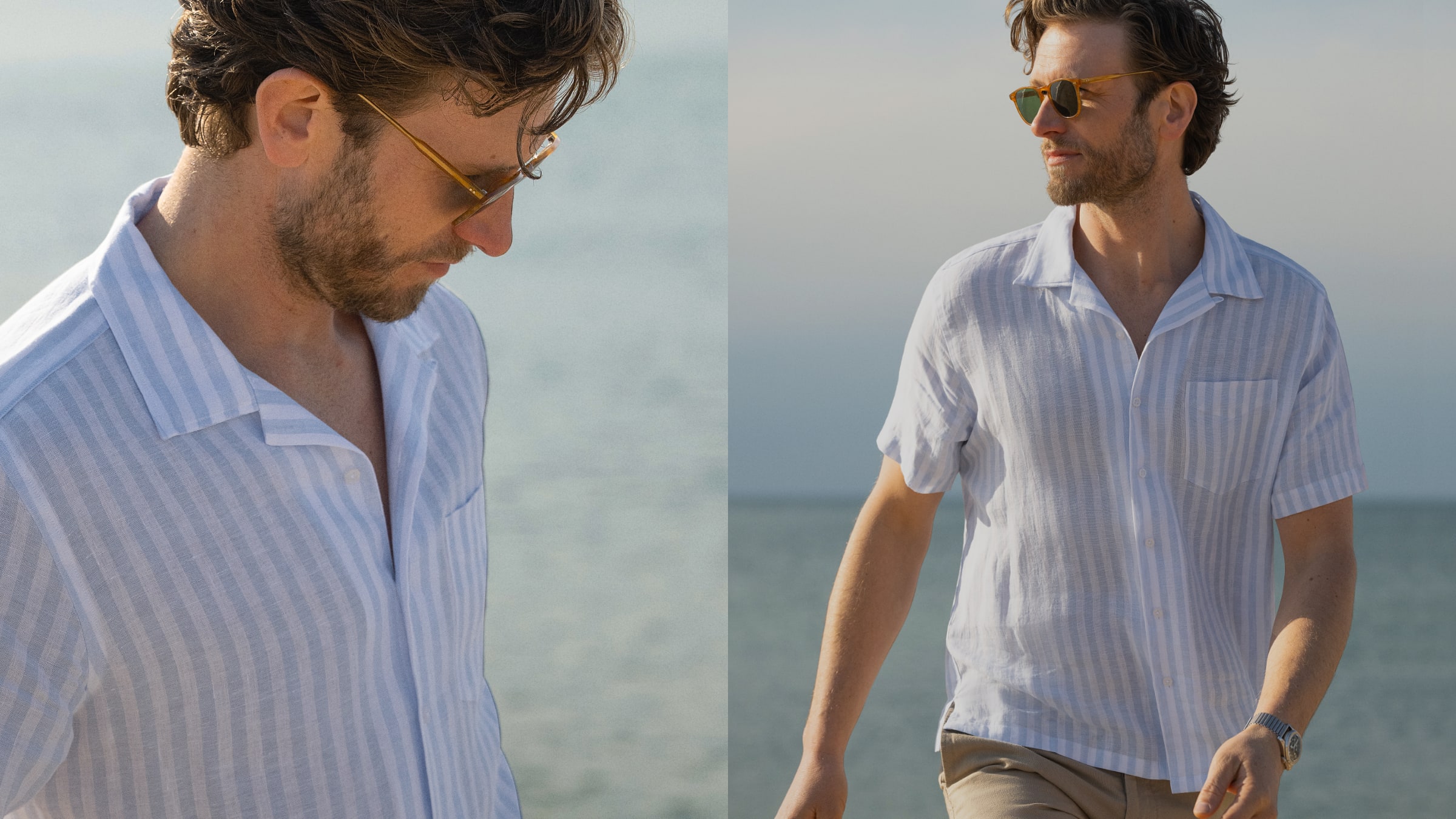
Some high thread count fabrics come in interesting weaves like jaquard or damask rather than the more common pinpoint, oxford cloth or broadcloth weaves. That’s not a bad thing – some of these fabrics are extremely beautiful and we like them a lot. However, if you assume that high thread-count implies thin and lightweight, you would be mistake. For example, this white with blue pinstripes textured weave has 140 threads per inch. It is super smooth and beautiful, however it is not an especially thin fabric.
If the fabric is a broadcloth, voile, oxford, or pinpoint, than it’s safe to assume that the higher thread count will be thinner and lighter than the lower thread count choice.
Type of Cotton Matters
Yarns a fabric is made of can have varying qualities. High quality cottons include Sea-Isle cotton, Pima cotton, or Egyptian cotton. Truth is, these are all just different names for the same cotton plant: Gossypium Barbadense. There could be other names for it too. It is more desirable for its “longer staples” which allow it to be threaded into finer, stronger threads. Pretty much everything else (95% of cotton clothes) uses the species Gossypium Hirsutum, more commonly not mentioned at all referred to as Upland, or Mexican Cotton. *Memorize these facts and you can surely impress your boss next time he brags about his shirts on the golf course.
Region (Kind of) Matters
We wish we could say that Italian Fabrics are better than Egyptian fabrics, or something like this, but it’s not that simple. Truth is, while Italy continues to lead the industry in top textiles, there is increasingly good fabrics coming from Japan, China and the US. There are also a lot of terrible fabrics coming from all of these places. If we had to gamble, we would put our money on Italy though, which is where Proper Cloth sources all of its shirt fabrics for premium custom dress shirts.
The Fabric Mill Matters
Cotton plants don’t automatically turn themselves into beautiful textiles. There is a lot of work that needs to be done to clean, spin, dye and weave the threads together. Seemingly small and unnecessarily complicated things like the minerals in the water used to rinse the fabric come into play. Even we have trouble distinguishing the marketing madness from real quality that you can appreciate.
Now, if everything else is equal but the fabric mill, we suggest going with a name that you can trust. Some fabrics feel great in the store, but wear out after just a few washes. A good fabric should get softer and nicer as you wash it.
3 Trackbacks
You can leave a trackback using this URL: http://propercloth.com/blog/2009/understanding-dress-shirt-thread-count/trackback/
[...] Understanding Dress Shirt Thread Count There are also a lot of terrible fabrics coming from all of these places. [...]
[...] Understanding Dress Shirt Thread Count | The Proper Blog [...]
[...] won’t even go into this too much, because it’s a deep subject with varying opinions on thread count, ply, country of origin, mill, type of weave, yarn treatment, materials, etc. It all comes down to one thing though: the fabric makes the shirt. So get something [...]
4 Comments
so i have a question more than a comment, why would an italian mill be better than say a swiss mill? they all use the same u.s. pima, i suppose the yarn spinner is the key and the craftsmen who operate the looms. i love italian cotton but there is just something about swiss, you notice it when you’re ironing it – you’ve done the research what is that?
Tam,
I don’t have much experience with Swiss mills – so don’t have a real definitive answer. There are great fabrics coming from all over the world these days, so it can be misleading to assume that because a fabric is from one country or another that is is superior or inferior. The quality of a fabric can be influenced by the water supply of a region. Different rivers have different pH balances, vitamins and minerals flowing in them (and other fairly complicated stuff). When the textile is dyed and rinsed, the water quality can have a major effect.
I am trying to find high quality white shirts. Non transparent good color depth like the kind that Clooney wore in the OCEANS series. Tom Ford has a nice one with a high collar but I cant judge the fabric. I won’t buy a $300.00 non custom shirt anyway.
Go for one of our new twills. Not too heavy, but fairly opaque.