How to Measure Pants: Waist Width

Measure Straight Across the Top of the Waistband

To measure the Waist Width, lay the pants down, face up, on a flat surface. Use your hands to spread the pants out flat, with the waistband buttoned at the front and the fly zipped closed. The front of the waistband should lie directly on top of the back of the waistband. Measure across the top of the waistband from one side of the pant to the other. The Waist Width is equal to half of the waistband’s total circumference.

The front of the waistband should lie directly on top of the back of the waistband.

Understanding Vanity Sizing for Pants

Like most pants, the base sizing for our pants’ waistbands includes vanity sizing. This means selecting the option for a 30” waist in the Smart Size quiz or ordering/creating a size from one of our Standard Size options will produce pants measuring roughly 31.75” in the circumference of the waist, which will display as a 15.9” Waist Width. 

All other dimensions, including Inseam Length, are true to measurement. We recommend choosing the waist size you usually wear off the rack for pants or jeans. For exact garment measurements, refer to the dimensions provided on the size generator.

Providing your waist size in the Smart Size quiz will generate a pants size with a ‘vanity size’ adjustment to the Waist Width dimension. All dimensions, however, are customizable.
Choosing a ‘Standard Size’ of 32×30.5 for pants yields a ‘vanity size’ Waist Width of 16.9″ (33.8″ in total circumference). All dimensions, however, are customizable.

Measuring Your Body for Waist Width: Consider the Rise

To determine the appropriate Waist Width measurement, you’ll first need to confirm that the waistband is resting at the height/place you normally wear your pants. Your preference for a higher or lower rise will determine how small or large the waistband needs to be to fit correctly.

Below are 3 rise options to consider:

  • Low Rise: Rests at the hip bones
  • Mid Rise: Rests between the navel and hips
  • High Rise: Rests at or above the navel/natural waistline

How to Measure Pants: Hip Width

The Hip Width measurement determines the widest part of the seat of the pants. With the pants lying face up on a flat surface, button the waistband, zip the fly closed, and use your hands to spread the pants out flat. Starting 7” below the top of the waistband, measure across the front of the pants, parallel to the waistband, from one side of the pants to the other.

Points of measurement for hip width on pants.

Pant Hip Width Measurement vs. Body Measurement

If you typically have issues with achieving a proper fit in the seat of your pants, measuring your body around the fullest part of your hips/seat area can help identify the right Hip Width for your saved custom pant size(s). The total circumference of the hips of the pants should be 0.7-1.5” bigger than your body measurement around the fullest part of the seat. Add 0.7-1.5″ to your hip body measurement, then divide it in half. This will yield the Hip Width to save in your custom pant size. 

For example, if your hips/seat measure 40.0” all the way around your body, a Hip Width of 20.75” (41.5″ in circumference) should be a comfortable fit.

Hip Width Measurements for Pleated vs. Non-Pleated Pants

Pleated trousers are constructed differently from non-pleated trousers, requiring an entirely new sewing pattern. This is because the pleats are open when the garment measurements are taken, but they are closed when the trousers are cut and sewn, so keeping the same Hip Width as your non-pleated trousers will cause the pants to become too tight around the hips. For this reason, you’ll need to create a special size with a larger Hip Width to order pleated trousers. For Single Pleat Trousers, increase your Hip Width 0.8” from your No Pleat pant size. For Double Pleat Trousers, increase your Hip Width 1.3” from your No Pleat pant size. Tips for creating a Pleated Pant Size. More information about Trouser Front (pleat) options.

How to Measure Pants: Thigh Width

Lay the pants flat on their sides, so that the legs are folded along the front and back creases. Fold the top leg up over the waistband, making the bottom of the crotch visible. Use your hands to spread out and flatten the bottom pant leg across the thigh. Measuring 1” below the lowest part of the crotch (where the inseams of each leg meet), measure straight across the width of the leg, perpendicular to the inseam.

Measuring Thigh Width

How to Measure Pants: Knee Width

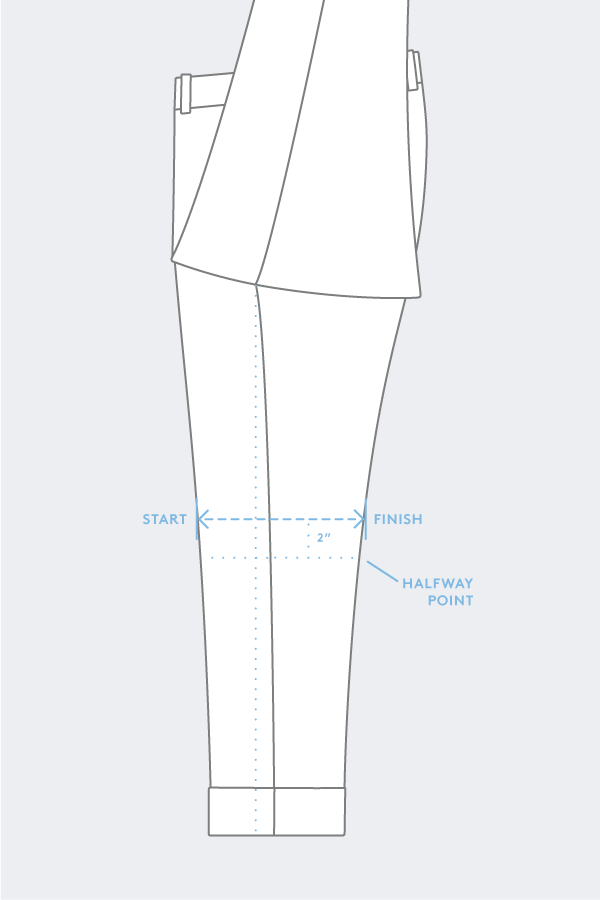
Lay the pants flat on their sides, so that the legs are folded along the front and back creases. Fold the top leg up over the waistband, making the bottom of the crotch visible. Use your hands to spread out and flatten the bottom pant leg. The knee width should be measured 2” above the halfway point of the inseam. At this point, measure straight across the width of the leg, perpendicular to the inseam.

Measuring Knee Width

How to Measure Pants: Leg Opening Width

Lay the pants flat on their sides, so that the legs are folded along the front and back creases. Fold the top leg up over the waistband, making the bottom of the crotch visible. Use your hands to spread out and flatten the lower end of the bottom pant leg. Measure across the bottom of the pant hem, from one edge of the leg opening to the other.

Measuring Leg Opening Width

How to Measure Pants: Front Rise

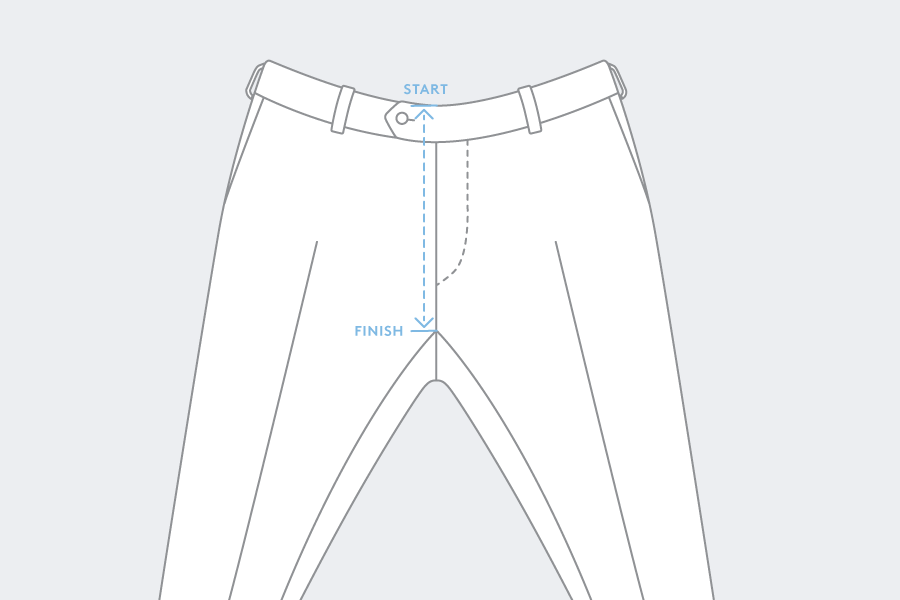
With the pants laying face up on a flat surface, use your hands to spread the pants out flat, with the waistband buttoned at the front and fly zipped close. Spread the legs further apart from one another than their resting position, such that the bottom of the crotch is clearly visible. Measure from the top of the waistband down along the fly to where the inseams of the legs meet one another.

Measuring Front Rise

How to Measure Pants: Back Rise

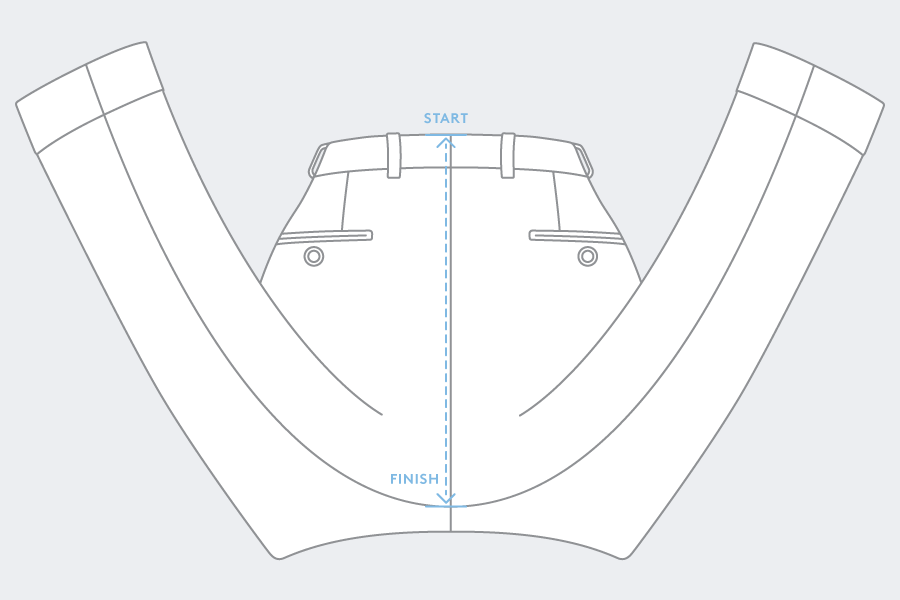
With the pants lying flat, face down, spread the legs further apart from one another than their resting position. Then, fold the legs upward so that the leg openings rest above the waistband. Pull down on the bottom of the crotch until the intersection of the inseams is visible. Measure from the top of the waistband down along the center back seam to where the inseams of the legs meet one another.

Measuring Back Rise

How to Measure Pants: Inseam Length

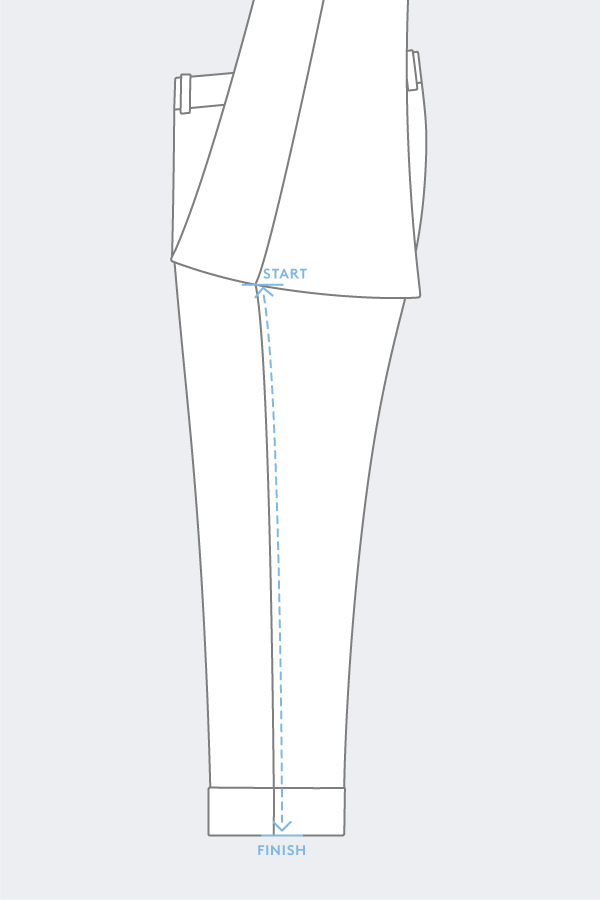
Lay the pants flat on their sides, so that the legs are folded along the front and back creases. Fold the top leg up over the waistband, making the bottom of the crotch visible. Use your hands to straighten out and flatten the bottom pant leg. The inseam length is measured from the bottom of the crotch (where the inseams meet), down the inside of the leg to the bottom of the leg opening.

Measuring Inseam Length

How to Measure Pants: Total Length

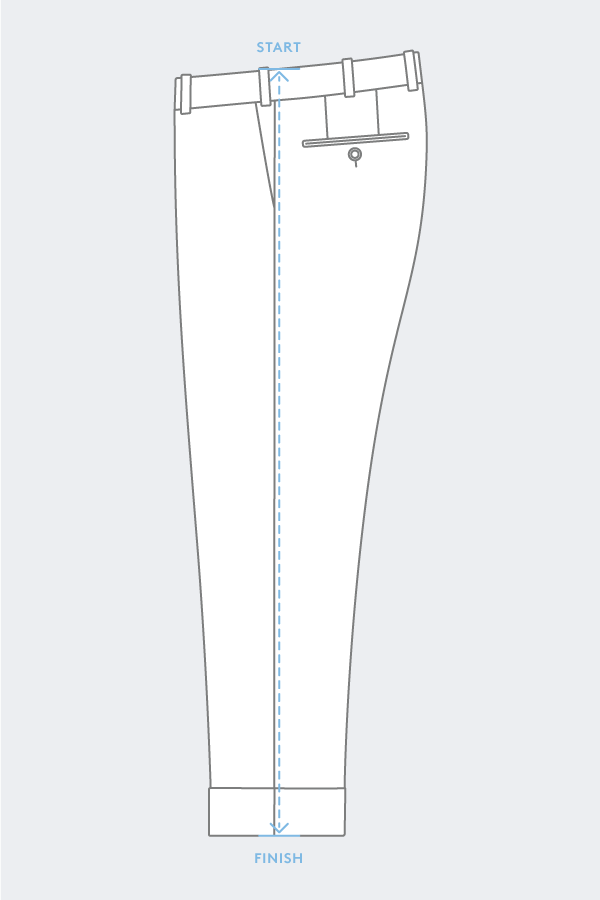
Lay the pants flat on their sides, so that the legs are folded along the front and back creases. Use your hands to straighten out and flatten the pant legs. Measure from the top of the waistband down to the bottom of the leg opening, following along the side seam of the leg.

Measuring Pants Total Length

How to Measure a Jacket: Shoulder Width

Lay the jacket face down. Use your hands to smooth and flatten out the body of the jacket. Measure from where the shoulder seam meets the sleeve on one side of the jacket straight across to where the shoulder seam and sleeve meet on the other side.

Where to measure suit jacket shoulder width

How to Measure a Jacket: Chest Width

Lay the jacket on its back. It’s important that the jacket is buttoned up fully. Use your hands to extend and flatten out the chest and torso completely. The bottom front hem (quarters) of the jacket should fall below the back hem of the jacket, such that the jacket can lay as flat as possible along the sides. Pop the collar up such that the lapels lay over each other as flatly as possible. Position the sleeves pointing up so that you can find the absolute corner where the side of the jacket meets the armpits. Measure from this point straight across the suit jacket to the opposite edge where the armpit and torso meet.

Where on a suit jacket to measure the chest width

How to Measure a Jacket: Midsection Width

With the jacket laying on its back and fully buttoned, again use your hands to extend and flatten out the torso completely. Measure straight across from one edge of the jacket waist to the other edge. On a two button jacket, position the measuring tape straight along the top button. On a 3 button jacket, the measuring tape should pass right through the middle button.

Where on a suit jacket to measure the waist midsection

How to Measure a Jacket: Center Back Length

Lay the jacket face down. Pop the collar such that the melton (felt) is visible beneath the collar. Starting from the intersection of the back, collar and center back seam, measure down along the center back seam to the bottom hem of the jacket.

Where on a suit jacket to measure the center back length

How to Measure a Jacket: Hip Width

With the jacket laying on its back and fully buttoned, again use your hands to extend and flatten out the body of the jacket completely. Measure straight across from one edge of the jacket’s hips to the other edge. On a two button jacket, position the measuring tape horizontal across the body, starting 6″ below the top button. On a 3 button jacket, the measuring tape should cross the body horizontally, 6″ below the middle button.

Where on a suit jacket to measure the hip width

How to Measure a Jacket: Sleeve Length

Lay the jacket face up. Use your hands to smooth and flatten the sleeve down alongside the body. Measure from the beginning of the sleeve where it meets the top shoulder seam, following the curve of the padding at the head of the sleeve before rotating straight down to the end of the cuff.

Where on a suit jacket to measure sleeve length

How to Measure a Jacket: Sleeve Bicep Width

Lay the jacket flat on its back. Pull the sleeve straight out to the side. The measurement should be 1” from the armpit up to the top of the sleeve, in a line that is perpendicular to the top of the sleeve.

Where on a suit jacket to measure sleeve bicep width